
The doorbell rings. Your puppy rockets across the room, launches himself at your visitor, and lands two muddy paws on her clean jumper while she tries not to spill her tea. You are apologising, grabbing at a collar, and wondering why your sweet puppy turns into a kangaroo the moment anyone visits. It is embarrassing, but it is also one of the most fixable habits in puppy training — because jumping up is not rudeness in dog language. It is a greeting.
Dogs greet each other face to face, and your puppy is simply trying to reach faces the only way he can. Worse, jumping has probably always “worked”: people look at him, talk to him, touch him to push him off, and give him exactly the attention he wanted. The fix is not strength or shouting. It is a clear new rule, taught kindly: four paws on the floor is how greetings happen, and jumping makes the fun pause.
Quick Answer
To stop a puppy jumping on guests, reward the behaviour you want instead: all four paws on the floor — or a calm sit — is what earns greetings, strokes, and treats. When he jumps, everyone calmly turns away, arms crossed, until the paws come down, then the greeting resumes. Brief your visitors before they come in, keep the puppy on a lead or behind a gate for the first minutes, and practise with planned helpers. Most puppies improve within a couple of weeks of everyone following the same rule, every time.
Why Puppies Jump Up
It is how dogs say hello
Puppies lick their mother’s face to greet her and ask for food, and adult dogs still greet nose to nose. A human face is far above a puppy, so he does the maths and jumps. Understanding this matters: you are not correcting bad manners, you are teaching a foreigner your local custom — down here, please.
Jumping gets rewarded by accident
Attention is attention. Guests who push him down are touching him. Children who squeal and wave their arms are playing with him. Even “OFF! DOWN! NO!” delivered at full volume is an exciting human making a fuss over him. Meanwhile, the quiet puppy standing politely on the floor often gets ignored — so of course he jumps. Your training flips this economy: the floor is where good things happen.
Teach the New Rule: Four Paws on the Floor
Step 1: Reward the floor generously
Set up small practice greetings at home. Approach your puppy yourself; the moment all four paws are down, mark it with a cheerful “yes!”, a treat delivered low — at his chest or on the floor — and a calm stroke. Repeat in short bursts. Treats delivered low matter: food arriving at floor level teaches that the floor is the interesting place.
Step 2: Add a sit for greetings
Once a sit is solid in quiet moments, ask for it as people approach: sit, then greeting. Some puppies find “stand calmly” easier than sitting when excited — either is fine. What you are teaching is a job to do instead of jumping: an alternative behaviour that earns the same reward.
Step 3: Make jumping boring
When he jumps anyway, the nearest person folds their arms, turns sideways, looks away, and says nothing for a few seconds. The instant paws land on the floor, attention and praise switch back on. No drama, no pushing, no commentary — the contrast does the teaching. Repeat patiently; the first sessions may take many repetitions, and then suddenly it clicks.

Brief Your Guests Before They Arrive
Guests are your training partners whether they know it or not, so give them the script in advance, kindly and briefly: “We are teaching him not to jump. Please ignore him completely while he is bouncy — arms crossed, turn away — and fuss him only when his paws are on the floor. Treats are by the door for the calm moments.” Most people are delighted to help when they know how, especially when you frame it as a game the puppy is learning.
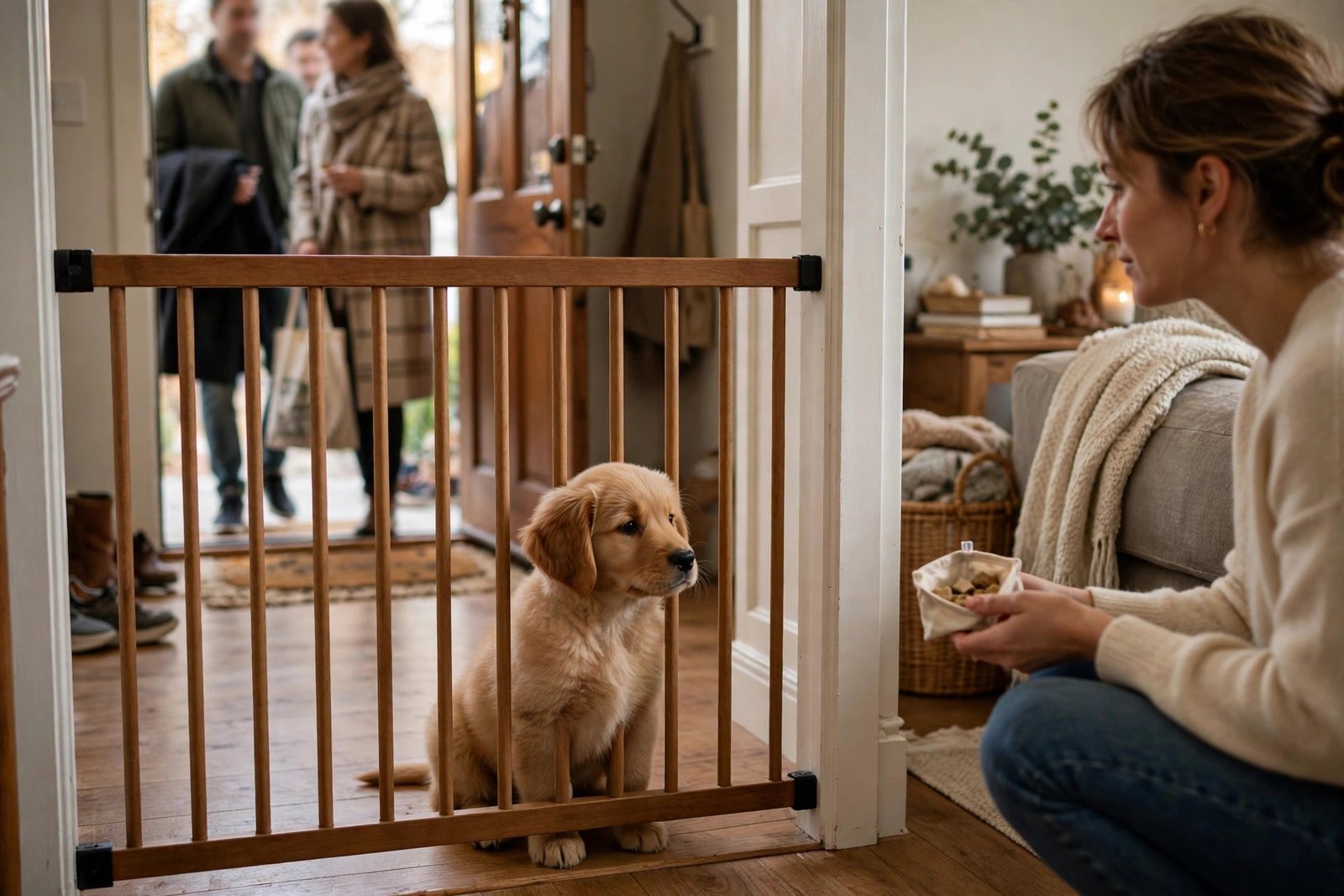
For the first minutes of a visit, management keeps everyone successful: puppy on a lead held by you, or behind a baby gate where he can see the arrivals and calm down before joining them. Greet your guest yourself first, let the excitement drain, then bring the puppy in for his practised, paid greeting.
Practise With Planned Visitors
Real guests are the exam; arrange rehearsals first. Ask a friend to do repeated calm entries: knock, come in, ignore jumping, reward calm, go out, repeat. Scatter a few treats on the floor as they enter — a nose hunting treats on the ground cannot be up on a guest, and it builds the association that arrivals mean floor-level goodies. Keep rehearsals short, cheerful, and frequent rather than rare and long. If your puppy is wildly excitable around new people generally, the gradual, distance-based approach in our guide on how to socialise a shy puppy safely works just as well in reverse — build calm at a distance first, then let visitors come closer.
Jumping at Family, Children, and People on Walks
The rule must be universal, or it is not a rule. Family members are usually the worst offenders, greeting the puppy with high voices and open arms and then complaining about jumping on strangers. Everyone in the home uses the same boring turn-away and the same paid floor. With children, supervise every greeting: children stand “like a tree”, arms folded, while an adult manages the puppy, and children are never left to handle jumping alone — a jumpy, mouthy puppy and a squealing child escalate each other fast, and the mouthing side of that spiral is covered in our guide on puppy biting everything.
On walks, ask approaching strangers kindly: “He is learning — could you wait until he sits?” and step on the lead or hold it short enough that he cannot reach them if they ignore you and rush in. Practising polite greetings out and about is part of general outside manners, and if your puppy currently goes deaf the moment you step out of the door, work through our guide on puppy not listening outside alongside this one — the two skills lift each other.
Mistakes to Avoid
- Do not push your puppy down, knee him in the chest, squeeze his paws, or step on his toes. These old-fashioned methods can hurt a small puppy, and pushing in particular reads to him as rough play — it makes jumping more excited, not less.
- Do not shout “OFF!” or “DOWN!” at a jumping puppy. Volume is excitement, and an untrained word is just noise. Teach the calm alternative behaviour first; a cue only means something once the puppy knows what earns a reward.
- Do not let guests reward jumping “because they don’t mind”. One person paying jumping with attention undoes the lesson for everyone else. Take charge kindly: your house, your puppy, your rules.
- Do not only practise with real guests. Unrehearsed chaos is the hardest level; puppies need many easy, staged greetings before the real thing goes smoothly.
- Do not ignore the calm puppy. If four paws on the floor never earn anything while jumping earns a reaction, the maths is obvious. Pay the behaviour you want, promptly and often.
- Do not force greetings on a puppy who is hanging back. A shy puppy who does not want to approach should be allowed to watch from a safe distance — confidence grows at his pace, not the visitor’s.
Frequently Asked Questions
How long does it take to stop a puppy jumping on guests?
With consistent responses from everyone, most puppies are visibly better within one to two weeks of daily practice, and reliable within a couple of months. Speed depends mostly on consistency: a puppy who is ignored for jumping by nine people and played with for it by one will keep trying — understandably. Expect extra excitement with favourite visitors and children, and manage those greetings with a lead until the habit is strong.
Should I teach the word “off”?
You can, but teach the behaviour before the label. Once your puppy reliably keeps four paws down and turns to you at greetings, pair the word “off” with the moment he chooses the floor, then reward. Used that way, the cue becomes a helpful reminder. Shouted at a puppy who has never been taught an alternative, it is just another exciting noise in the chaos.
What if my guests encourage the jumping?
It happens, especially with dog-loving friends. Be cheerful and direct: explain he is in training, show them the treats by the door, and keep the puppy on a lead near you so you control the greeting. If a guest truly will not cooperate, let the puppy enjoy the visit from behind a gate with a chew — protecting the training matters more than one evening’s cuddles, and your guest can still say hello over the gate when the paws are down.
My puppy jumps up and mouths at the same time. Is that different?
It is the same over-excitement wearing two hats, and the fix is the same calm system: turn away, paws or teeth end the interaction, good choices get paid. Add plenty of legal chewing and proper sleep — overtired, under-chewed puppies jump and mouth most. If the behaviour ever looks different in kind — stiff body, hard staring, growling while guarding things — skip the home training and book a vet check followed by a qualified reward-based behaviourist.

1 thought on “How to Stop a Puppy From Jumping on Guests, Politely”