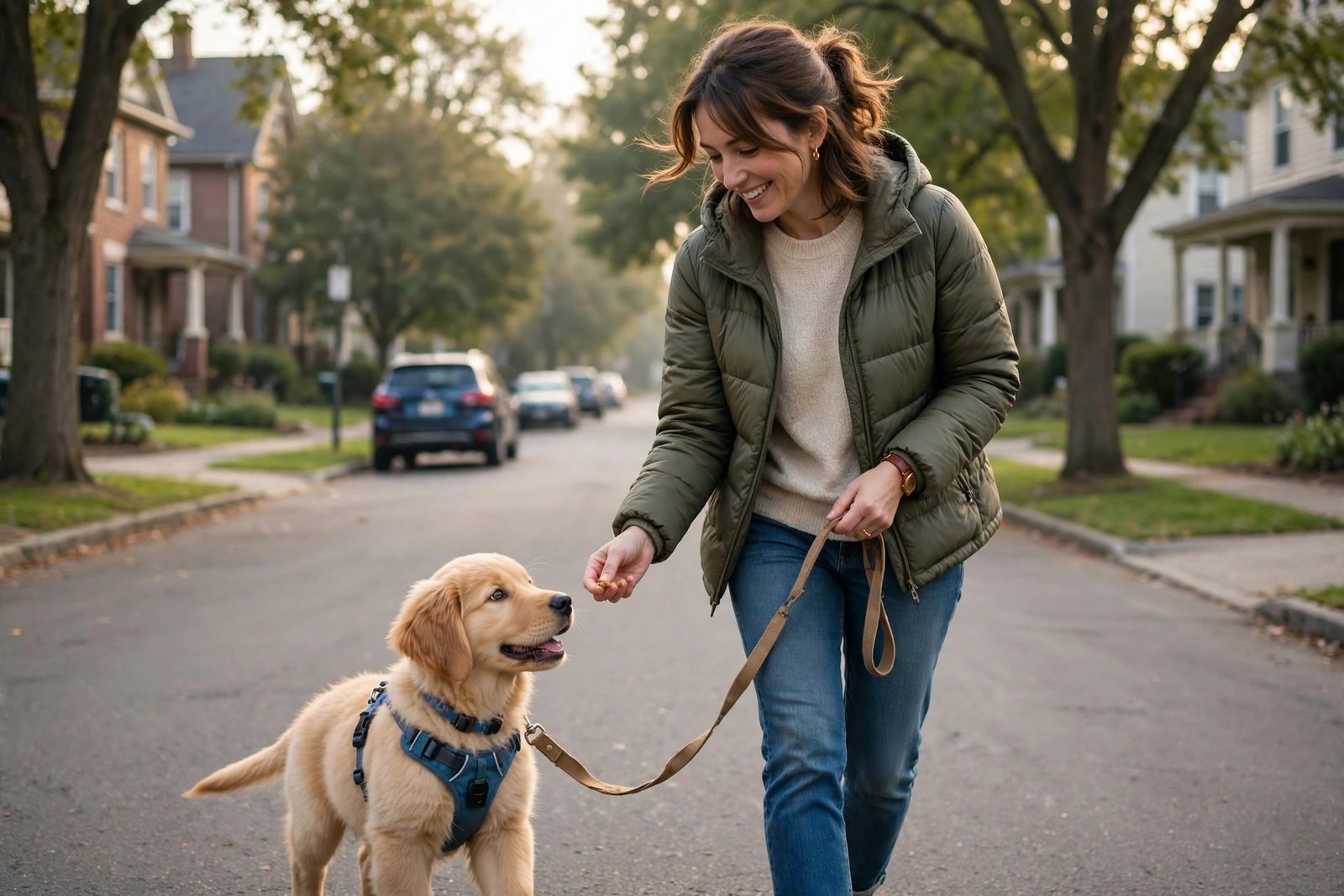
Your first walks were supposed to be dreamy. Instead, your puppy pulls like a tiny sled dog, zigzags across the path, wraps the leash around your legs, and sits down dead still the moment you actually need to get somewhere. Take heart: almost nobody’s puppy walks nicely at first, because walking beside a human at human speed is one of the least natural things we ever ask a dog to do.
The good news is that leash walking is a skill like any other, and puppies learn it quickly when the rules are simple and the rewards are generous. You do not need special tools or a firmer hand. You need a well-fitting harness, a pocket of good treats, short sessions, and one clear message repeated kindly: walking near me is where the good things happen.
Quick Answer
Start indoors or in the garden, rewarding your puppy for walking beside you on a loose leash, and make a tight leash boring: when it pulls taut, stop and wait, then move on the moment it slackens. Keep early walks short and sniffy, pay often, and build distance and distractions gradually. Most puppies walk politely on quiet streets within a few weeks of this kind of practice.
Why Puppies Pull (It Is Not Defiance)
Puppies walk faster than we do
A puppy’s natural pace is a brisk trot with frequent stops to sniff. Your walking pace is, to him, a slow-motion shuffle. Pulling is usually just a young dog trying to travel at the speed his body wants to go. He is not trying to lead the pack or win an argument — he is trying to get to the interesting smell before it evaporates.
Pulling works
Every step you take while the leash is tight teaches him that pulling moves the walk forward. Dogs repeat what works. This is why the “stop when it pulls” rule matters so much: the day pulling stops working and loose-leash walking starts paying, the behaviour flips remarkably fast.
The world is overwhelming
New streets mean new dogs, people, traffic, bins, pigeons, and a thousand smells. A puppy who walks beautifully in your kitchen is not being stubborn when he falls apart on a busy road — he is over-faced. Skills have to be rebuilt at each level of distraction, which is exactly why our guide to a puppy not listening outside pairs so well with leash work: attention first, then steps.

What You Need (and What to Skip)
- A well-fitting harness with a back attachment, adjusted so you can slip two fingers underneath. A harness spreads pressure across the chest instead of the throat.
- A standard fixed-length leash, around 1.5 to 2 metres. Long enough for slack, short enough to manage.
- Small, soft, high-value treats — pieces of chicken, cheese, or hot dog often beat dry biscuits outdoors — in a pouch or pocket you can reach fast.
- Patience with distance: the garden, the driveway, and the quiet end of your street are your first training grounds, not the dog park.
Skip anything designed to hurt or startle him into position: choke chains, prong collars, and shock collars have no place in puppy training, and retractable leashes teach the opposite lesson — that steady tension on the leash is normal. A simple harness and leash, used consistently, are genuinely all you need.
Step One: Teach the Magic Spot at Home
Leash walking starts off the street. In your kitchen or garden, clip the leash on and simply reward your puppy every time he wanders into the area beside your leg — the “magic spot”. Take one step, treat if he comes with you. Take two. Change direction often and treat generously; make being beside you the best-paid job in the house. Five minutes of this game, twice a day, builds the foundation that street walks rely on. If your puppy is still getting used to the leash itself — chewing it, biting at it, or freezing when it clips on — spend a few sessions just wearing it indoors during play and meals until it is boring. Puppies who mouth everything, including the leash, are usually teething or overexcited; our guide to puppy biting everything covers redirecting that mouth onto legal targets.
Step Two: The Stop-and-Wait Rule
Out on a real walk, the rule is simple to say and takes practice to keep:
- Leash goes tight → you stop, stand still, and become a boring tree. No yanking back, no scolding, no leash jerks.
- Leash slackens — because he turns, steps back, or looks at you → mark “yes”, reward, and walk on.
- Repeat. Early walks may move at the speed of a sleepy snail. That is fine. You are not covering distance yet; you are installing a rule.
Many owners find it helps to reward far more often than feels reasonable at first — every few steps of loose leash, paid. You can space the treats out as the habit strengthens. What you are buying with all those treats is a puppy who checks in with you instead of towing you, and that habit is worth every crumb.
Step Three: Let Him Sniff — On Your Terms
A walk that is all marching is a miserable walk for a dog, and a puppy who never gets to sniff will pull harder to steal sniffs where he can. Build sniffing into the walk as a reward: after a stretch of nice walking, say “go sniff” and let him investigate the grass verge for a minute. Then a cheerful “let’s go” and back to walking. Sniff breaks actually improve leash manners, because the puppy learns the good exploring happens because he walks well, not by dragging you to it. An overtired or over-aroused puppy will still struggle, so keep early walks to around five minutes per month of age, once or twice a day, and remember that greeting people politely is part of street manners too — the calm four-paws-down routine in our article on how to stop a puppy jumping on guests works just as well for pavement greetings.

Building Distance and Distractions Slowly
Progress in small steps: garden, then driveway, then the quiet end of the street, then busier routes. At each new level, expect to pay more often and walk less far for a few days — that is normal learning, not regression. Practise passing distractions at a distance where your puppy can still notice you and take a treat; if he cannot eat, he is too close and too overwhelmed, so add space. Friendly off-leash dogs, children on scooters, and café pavements are final exams, not first lessons. Short, successful walks beat long chaotic ones every time, and ending while things are going well teaches faster than pushing on until it all falls apart.
Mistakes to Avoid
- Do not jerk the leash, yank him back, or “correct” pulling with the collar. Pulling against pain just makes puppies pull harder or fear the walk — and a puppy’s neck is delicate.
- Do not use choke chains, prong collars, or shock collars. They suppress behaviour through discomfort, can injure growing puppies, and teach nothing about what you actually want.
- Do not keep walking while he pulls “just this once” because you are in a hurry. Every rewarded pull is a rehearsal. If you are short on time, take a shorter training walk instead.
- Do not use a retractable leash for training. Its constant light tension teaches puppies that a tight leash is the normal state of things.
- Do not drag a puppy who has planted his feet. A frozen puppy is usually worried or overloaded, not stubborn. Crouch down, call him happily towards you, reward, and retreat to an easier route.
- Do not expect adult manners from a baby. Loose-leash walking takes weeks of short sessions; wobbles at new distractions are part of learning, not failure.
Frequently Asked Questions
How long does it take to teach a puppy to walk nicely on a leash?
Most puppies walk politely on familiar, quiet streets within three to six weeks of short daily practice. Busier environments take longer, because each new level of distraction restarts part of the learning. Adolescence (around six to twelve months) often brings a temporary relapse — go back to paying often and keeping walks simpler for a while, and the habit returns.
Harness or collar — which is better for a puppy?
A well-fitting harness is the kinder choice while a puppy is learning, because pulling then presses on the chest rather than the throat. Collars are fine for ID tags. Whichever you use, it is the training — rewarding position, stopping for tension — that creates nice walking, not the equipment.
My puppy bites and chews the leash. What should I do?
Leash chewing usually means excitement, teething, or frustration. Stay calm, avoid a tug-of-war (that makes it a game), and redirect him onto a carried toy or a “watch me” cue followed by a treat. Practise the harness-and-leash game indoors where he is calmer, and if he is wild and bitey, he may simply be overtired — end the walk and try again after a nap.
Should I use a retractable leash so my puppy has more freedom?
Not during training. The constant tension of a retractable leash teaches a puppy that pulling is how the world works, and the thin cord can tangle or injure. For freedom in safe open spaces, a long training line (held properly, attached to a harness) gives real room to explore while you keep building recall — without teaching him to tow you down the pavement.

1 thought on “How to Teach a Puppy to Walk on a Leash Without Pulling”