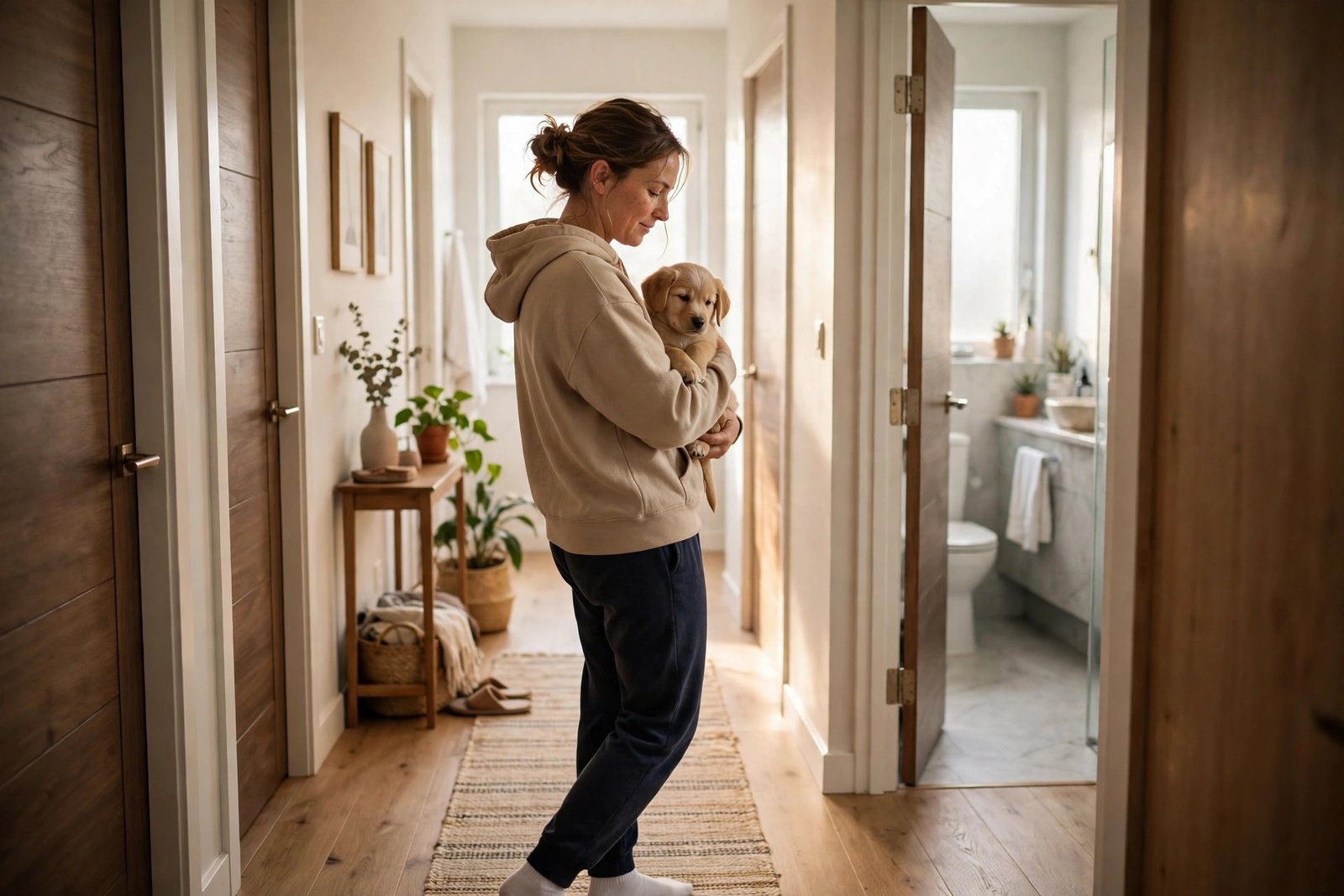
Potty training is the first big test of puppy life, and apartment living adds its own twist: no garden door to open, a lift or stairs between you and the street, and neighbours below who will hear every midnight trip. It can feel like a race you are always losing. The truth is kinder than that: puppies are not being stubborn or dirty — their bodies are small, their control is immature, and they simply have not learned your rules yet.
With a clear routine, fast trips outside, and generous rewards, most apartment puppies learn the pattern within a few weeks and become reliable over the following months. This step-by-step guide shows you how, including balcony and indoor-toilet options for high-rise homes.
Quick Answer
To potty train a puppy in an apartment, take him to his toilet spot very often — after waking, after meals, after play, and at least every one to two hours — and reward him warmly the second he finishes toileting there. Choose one system and stick to it: trips downstairs, a balcony grass patch, or an indoor litter or pad area for very young or high-rise puppies. Use a crate or small pen for rest times, clean accidents with an enzymatic cleaner without any scolding, and expect steady progress over two to four weeks, with full reliability taking several months as his body matures.
Choose Your Toilet System First
Option 1: Outside every time
If you live on a low floor or have a lift, going outside from the start teaches the final goal directly. Pick one small area near your building as “the toilet place” and go to the same spot each trip. The familiar smell tells your puppy what this place is for.
Option 2: A balcony toilet patch
For high floors or very young puppies, a patch of real or artificial grass in a tray on the balcony is a kind, practical bridge. It keeps the important rules — toilet happens on grass, away from sleeping and eating areas — while cutting the trip to seconds. Rinse and clean it often, and start mixing in downstairs trips as your puppy grows, so the habit transfers outside.
Option 3: An indoor toilet area
Pads or a litter tray in one fixed place can work for tiny breeds, very high floors, or owners with limited mobility. Choose one spot, away from the bed and bowls, and keep it consistent. Be aware that some puppies learn “soft indoor surfaces are fine”, which can include your rug, so if you later want fully outdoor toileting, a balcony patch usually transfers more easily than pads.
Whatever you choose, choose once and commit for at least the first weeks. Switching systems every few days resets learning. If night-time trips are your biggest worry, know that they settle quickly as bladders grow — and our guide on puppy crying at night in the crate covers calm night routines that pair perfectly with the schedule below.

The Apartment Potty Training Schedule
Young puppies can usually hold on for roughly one hour per month of age, plus one — so about two to three hours for an eight-to-ten-week puppy, and less when he is awake and active. Rather than watching the clock alone, anchor trips to events, because events are when puppies need to go:
- Immediately after waking, in the morning and after every nap.
- About ten to twenty minutes after every meal and big drink.
- After play sessions, training, chewing, and excitement — including guests arriving.
- Last thing at night before bed, and during the night for the first weeks: most young puppies need one or two night trips at first.
- At least every one to two hours in between, while he is awake.
On each trip, carry or lead him quickly to the spot — in apartments, carrying a young puppy through the corridor and lift prevents most hallway accidents, because puppies rarely toilet while being carried. Stand still, be boring, and give him five calm minutes. Use one short cue phrase, like “go toilet”, said once, quietly. The instant he finishes, praise him like he has won something and give a small, high-value treat. That reward, in that place, in that moment, is the engine of the whole training.
Use a Crate or Pen to Help, Not to Punish
Puppies naturally avoid toileting where they sleep, so a correctly sized crate — big enough to stand, turn, and lie stretched out, but not big enough for a toilet corner — makes rest times between trips safe and teaches gentle bladder control. Build crate time up with treats, meals, and chews inside so it feels like a bedroom, never a prison. Never use the crate for long stretches beyond his physical ability to hold on, and never as punishment: if he has an accident in the crate, the schedule failed him, not the other way round.
Out of the crate, supervise constantly or use a playpen with his bed, water, and chews. A puppy you cannot watch is a puppy practising accidents. Watch for the warning signs — circling, sniffing the floor intently, squatting preparations, wandering to a previously used accident spot — and whisk him to the toilet place at the first sign. Puppies who are busy mouthing and playing forget their bladders entirely, which is why our guide on puppy biting everything also stresses scheduled rest and toilet breaks during play sessions.

Accidents: What to Do (and What Not to Do)
Accidents will happen in every home. They are information, not defiance. If you catch him mid-accident, interrupt gently with a soft sound — no shouting — carry him straight to the toilet place, and reward him if he finishes there. If you find it afterwards, simply clean it up quietly. He cannot connect your reaction now with something he did minutes ago.
Clean with an enzymatic pet cleaner that breaks down the smell completely. Normal cleaners may smell clean to you while leaving a scent message for your puppy that says “toilet here”. Blot, do not scrub the scent deeper, and keep him away until the area is dry. Then adjust the plan: accidents usually mean trips were too far apart, freedom came too early, or the last meal and play times shifted the pattern.
One special apartment note: a puppy who starts toileting at your front door is often trying to tell you something — he has learned the toilet is outside and is heading for the exit. That is progress, not failure. It is also why teaching a clear door routine matters as he grows, so he can signal without scratching; our article on how to stop a dog from scratching the door at night will be useful when he is older and the signals get louder.
A Realistic Week-by-Week Picture
In week one, expect several accidents a day and one or two night trips; your job is routine, not perfection. By weeks two to three, most puppies taken out often enough are having clearly fewer accidents and beginning to head towards the door, the balcony, or their patch. Over the following months, accidents become rare, but true reliability — holding on in new places, at new times, when excited — builds gradually until around six months and beyond. Keep rewarding outdoor toileting occasionally all through the first year; habits you keep paying are habits that stay.
See your vet if toileting suddenly goes backwards after good progress, if your puppy wees very frequently in tiny amounts, strains, cries when toileting, drinks much more than usual, or has ongoing diarrhoea. Medical problems wear the disguise of training problems, and they deserve a check before more training.
Mistakes to Avoid
- Do not rub his nose in it, shout, or punish accidents after the fact. It teaches fear of you, not control of his bladder, and puppies often start hiding to toilet instead.
- Do not give a young puppy free run of the whole apartment. Freedom is earned room by room as reliability grows.
- Do not mix systems day by day — pads today, balcony tomorrow, outside at weekends. One clear rule learns fastest.
- Do not bring him back inside the second he toilets and end all the fun. Walk or play for another minute after rewarding, or clever puppies learn to hold on to delay going home.
- Do not cut water in the evening to avoid night trips. Puppies need free access to water; plan the last meal earlier instead, and keep the last toilet trip right before bed.
- Do not expect an eight-week puppy to last the night. Night trips are normal and temporary.
Frequently Asked Questions
How long does potty training take in an apartment?
Most puppies show a clear pattern within two to four weeks of a consistent routine, with accidents dropping steadily. Full reliability usually takes four to six months, because bladder control is physical maturity, not just learning. Apartment puppies sometimes take a little longer to become perfect at signalling, simply because the toilet is farther away — a balcony patch or a bell by the door can close that gap.
Are puppy pads a good idea or a bad habit?
Pads are a tool, not a mistake. They make sense for very high floors, tiny puppies before vaccinations finish, and owners who cannot manage frequent stairs trips. The risk is a puppy who generalises “soft surface indoors is fine”. If your final goal is outdoor toileting, prefer a balcony grass patch where you can, use pads in one fixed place only if you need them, and start outdoor trips early alongside them.
How do I handle potty trips in the lift and hallway?
Carry young puppies in your arms or a carrier through shared areas until you reach the toilet spot; most will not toilet while held. Keep the route calm and quick, use the same exit and spot every time, and carry bags and a small clean-up kit for the accidents that do happen — neighbours forgive a puppy owner who cleans up fast and smiles. As he grows, walking on lead through the building becomes part of the routine trip.
My puppy toilets outside and then again inside ten minutes later. Why?
Young puppies often do not empty their bladder fully in one go, especially if they get distracted outside. Stay out a little longer, let him relax and wander after the first wee, and give him a chance to go again before coming in. Back inside, supervise closely for the next half hour or rest him in his crate or pen, and treat repeated double accidents as a sign the outside trip needs to be calmer and slightly longer.

3 thoughts on “How to Potty Train a Puppy in an Apartment, Step by Step”