
The postman walks past. A leaf blows across the path. Someone three gardens away closes a car door. And your puppy is at the window, barking like the house is under attack. If this sounds familiar, you are not alone — the window is one of the most exciting (and frustrating) spots in a young puppy’s whole world.
The good news is that window barking is one of the most fixable puppy habits there is. Your puppy is not being naughty, stubborn, or “dominant”. He is bored, excited, or a little unsure — and the window keeps rewarding him for barking, because every person and dog he barks at eventually walks away. Change what the window pays out, teach him what to do instead, and the noise drops far faster than most owners expect.
Quick Answer
Reduce what your puppy can see, reward calm watching before the barking starts, and teach a quiet “thank you, that’s enough” routine: name the trigger calmly, call your puppy away from the window, and pay him well for coming. Practised in short daily sessions, most puppies learn to watch the world quietly — or come and tell you about it with one bark instead of twenty — within a few weeks.
Why Puppies Bark at the Window
It works — every single time
From your puppy’s point of view, window barking is a magic trick that never fails. He barks at the postman, and the postman leaves. He barks at the dog across the road, and the dog leaves too. In his mind, the barking drove them away. A behaviour that “works” this reliably gets stronger fast, which is why this habit is worth tackling early rather than hoping he grows out of it.
The window is a television he never chose
A house can feel quiet and dull to a young dog, and then the window offers a full day of movement: people, dogs, cats, bikes, delivery vans. Puppies who spend long stretches parked at the window are often simply under-occupied the rest of the day. The barking is entertainment as much as anything else.
Some barking is worry, not excitement
Watch the body, not just the noise. A puppy barking with a loose, wiggly body and a wagging tail is mostly excited. A puppy who is stiff, leaning forward, with hard staring, raised hackles, or a high, tight bark may be anxious or frustrated. Worry-barkers need the same calm training, plus more distance from the trigger — never punishment, which adds fear to a puppy who is already on edge.
Barking is also a normal puppy language
Dogs bark. Puppies bark more — at new things, surprising things, and things they cannot reach. Your goal is not a silent dog. It is a puppy who can notice the world, maybe give one bark, and then settle or come to you. That is a realistic and kind target.
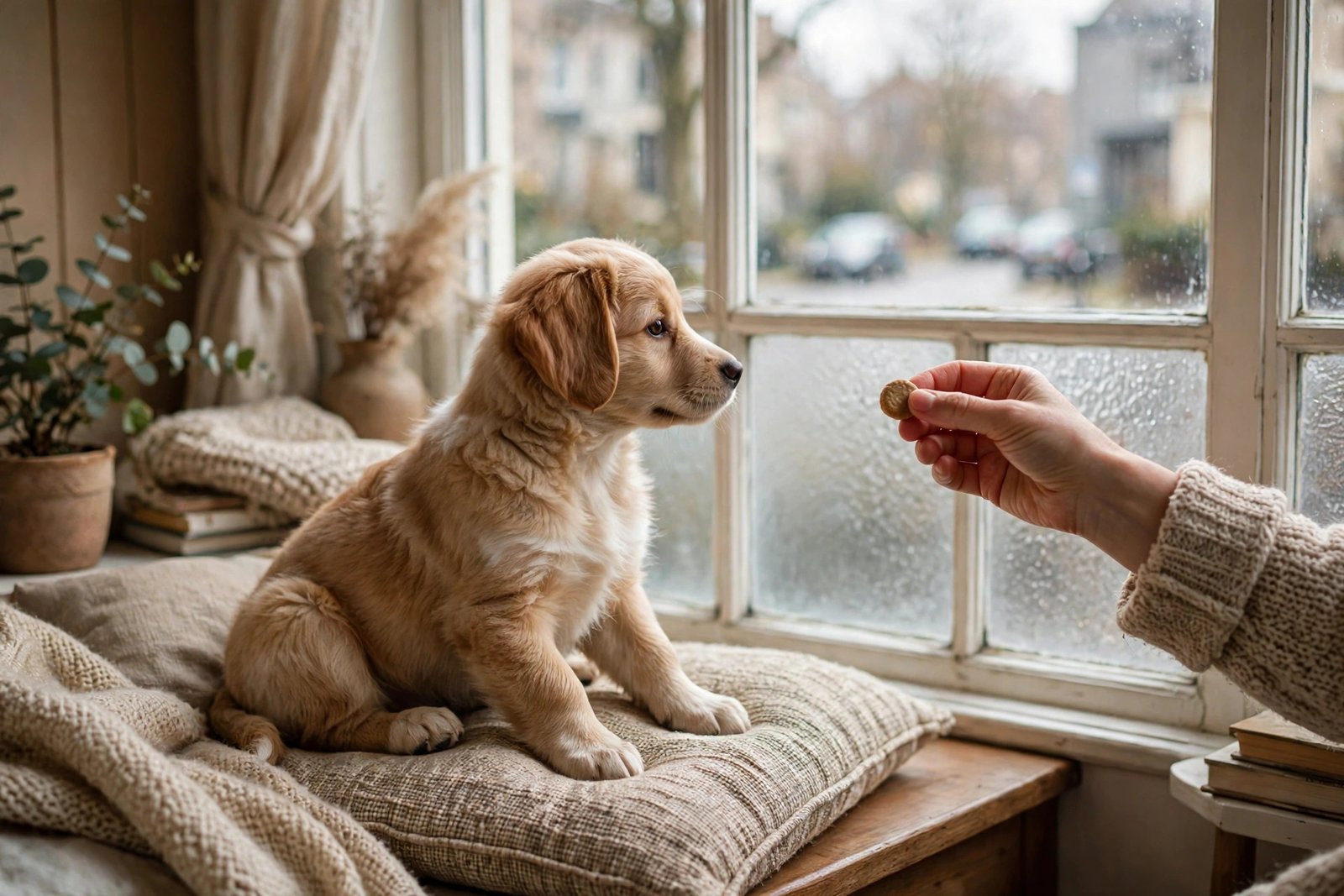
Step One: Manage the Window First
Training works much faster when the puppy is not practising the bad habit fifty times a day between sessions. Management is not cheating — it is what makes the training possible.
- Restrict access when you cannot supervise. Use a baby gate, a door, or a playpen so the window is not a full-time station during work calls and busy hours.
- Soften the view. Frosted window film on the lower panes, closing curtains at peak times (school run, post delivery), or moving a favourite perch away from the glass all lower the excitement without changing your home much.
- Move the excitement indoors. A puppy who has had a sniffy walk, a training game, and a chew is far less likely to run a one-dog neighbourhood watch. Boredom is the window’s best friend.
- Add background sound. Gentle radio or television noise can soften sudden outside sounds that trigger a barking round on an otherwise quiet street.
Step Two: Reward the Quiet Watching
Here is the part most owners miss: your puppy almost certainly looks out of the window calmly many times a day — and nobody pays him for it. Start catching those moments. Keep small treats near the window area (out of reach), and whenever he watches a person or dog pass in silence, mark it with a cheerful “yes” and give a treat. You are telling him, clearly and repeatedly, that quiet watching is the behaviour that pays.
Timing matters. Reward in the gap between seeing the trigger and barking — the ears-up, interested-but-calm moment. If you are too late and the barking has started, do not reward and do not scold; simply call him away (see below) and try again with the next passer-by. Short sessions of a few minutes, a few times a day, beat one long frustrated session.
Step Three: Teach “Thank You — That’s Enough”
This one routine handles the moments when barking does start, and it works because it gives your puppy a job that ends the episode instead of a shouting match that joins it.
- When he barks at something, say his name and a calm “thank you” — you are acknowledging the alert, not joining the alarm.
- Immediately call him away from the window to you, or toss a treat onto the floor away from the glass so he turns and hunts for it.
- The moment he is away from the window and quiet, mark and reward again, then give him something to do: a chew, a snuffle mat game, or a quick round of a known cue like “sit”.
- Repeat the same way every time. Consistency is what turns this from a trick into a habit.
Notice what is not in this plan: no yelling “quiet”, no spray bottles, no shaker cans, no startling him out of it. Those things either scare an already-aroused puppy or simply add your noise to his. Calm, boring repetition is what changes the behaviour. If your puppy also struggles to focus on you outdoors, where the triggers are bigger and closer, the same reward-based approach in our guide to a puppy not listening outside will build his attention step by step.
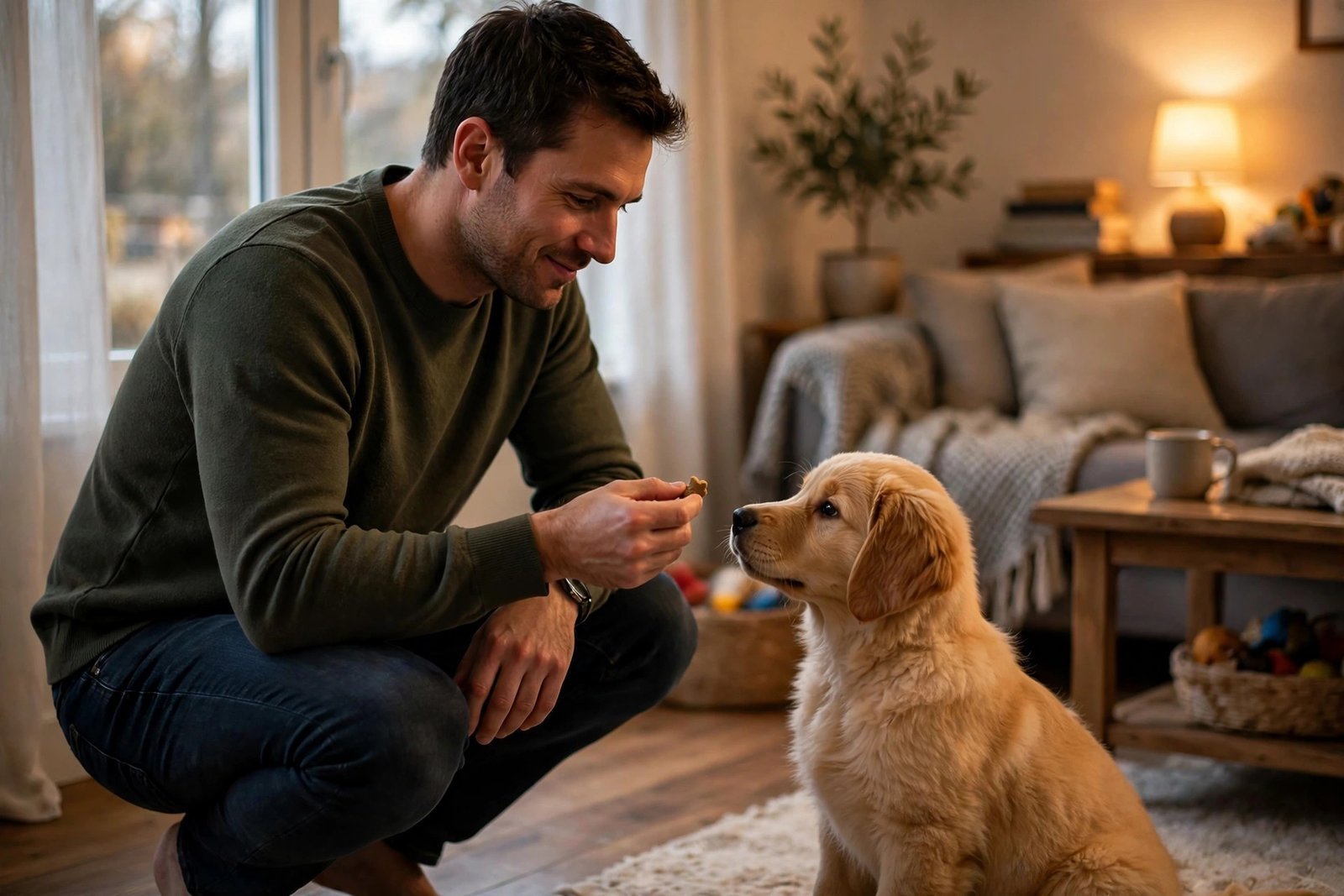
Step Four: Practise With a Set-Up
Real life at the window is fast and unpredictable, so a few planned rehearsals speed things up. Ask a family member to walk past the window at a distance, slowly, while you sit with your puppy and a pouch of good treats. The passer-by is boring on purpose — no waving, no approaching the glass. Reward every calm look. If your puppy barks, the helper simply keeps walking while you run the “thank you” routine. Over days, the helper can come a little closer or vary the act: a hat, a bike, a second person. You are building a puppy who has “seen it all before” and found it pleasantly dull.
Fill the Day So the Window Matters Less
Window barking shrinks when the rest of the puppy’s day is rich. Short training games, sniffy walks where he is allowed to investigate smells, cardboard boxes to shred, frozen stuffed toys, and proper naps all lower the urge to monitor the street. Remember that young puppies need a great deal of sleep — around eighteen to twenty hours a day — and an overtired puppy has a much shorter fuse at the window. Many “evening madness” barking fits are really a tired puppy who needs a nap, the same pattern behind puppy biting everything during the witching hour. And if your puppy follows you from room to room all day and can never quite switch off, our article on why dogs follow you everywhere explains how to build calm independence alongside this training.
Mistakes to Avoid
- Do not shout “quiet” or bark back. To your puppy, your shouting sounds like joining in — and if he is barking from worry, being shouted at makes the scary thing outside even more upsetting.
- Do not use spray bottles, shaker cans, or ultrasonic gadgets to startle him into silence. A startled puppy learns that things outside the window are dangerous, which often makes the barking worse within weeks, not better.
- Do not leave him at the window all day “to get used to it”. Unlimited rehearsal of barking makes the habit stronger, in the same way practising anything makes it stronger. Managed access plus short training wins.
- Do not reward the barking by rushing over with excitement, opening the door to show him, or giving a treat while he is still barking “to distract him” — the treat must follow the quiet moment, not the noise.
- Do not expect silence. One alert bark followed by settling is success. Punishing every sound teaches a puppy nothing except that the window is stressful.
Frequently Asked Questions
How long will it take to stop my puppy barking at the window?
Most owners see a clear drop within two to three weeks of daily short sessions plus simple management (limited window access and rewarded quiet watching). Puppies who have rehearsed the habit for months, or very alert breeds, may take longer — but the trend should be steady: fewer episodes, shorter episodes, and quicker settling after one bark.
Is window barking a sign my puppy will become aggressive?
Not on its own. Window barking is usually excitement, boredom, or frustration at a barrier, and it is extremely common in young dogs. That said, if the barking comes with hard staring, lunging at the glass, snapping, or it is getting worse despite calm training, book a session with a qualified reward-based behaviourist — early help keeps small frustrations from growing.
Should I close the curtains all day?
Closing curtains at peak trigger times is a sensible management tool, and frosted film on lower panes helps too — but use it alongside training, not instead of it. A puppy who never practises calm watching never learns it. Management lowers the rehearsal count; training builds the new habit.
My puppy only barks at certain things — like people with hats or other dogs. Why?
Because those things are novel, move differently, or have been especially rewarding to bark at before. Puppies have a socialisation window in which the world is being filed as “normal” or “strange”, and anything under-represented lands in the strange pile. The set-up practice above — a helper in a hat, walking past at a distance, paired with treats — is exactly how you shrink that list, one odd thing at a time.
