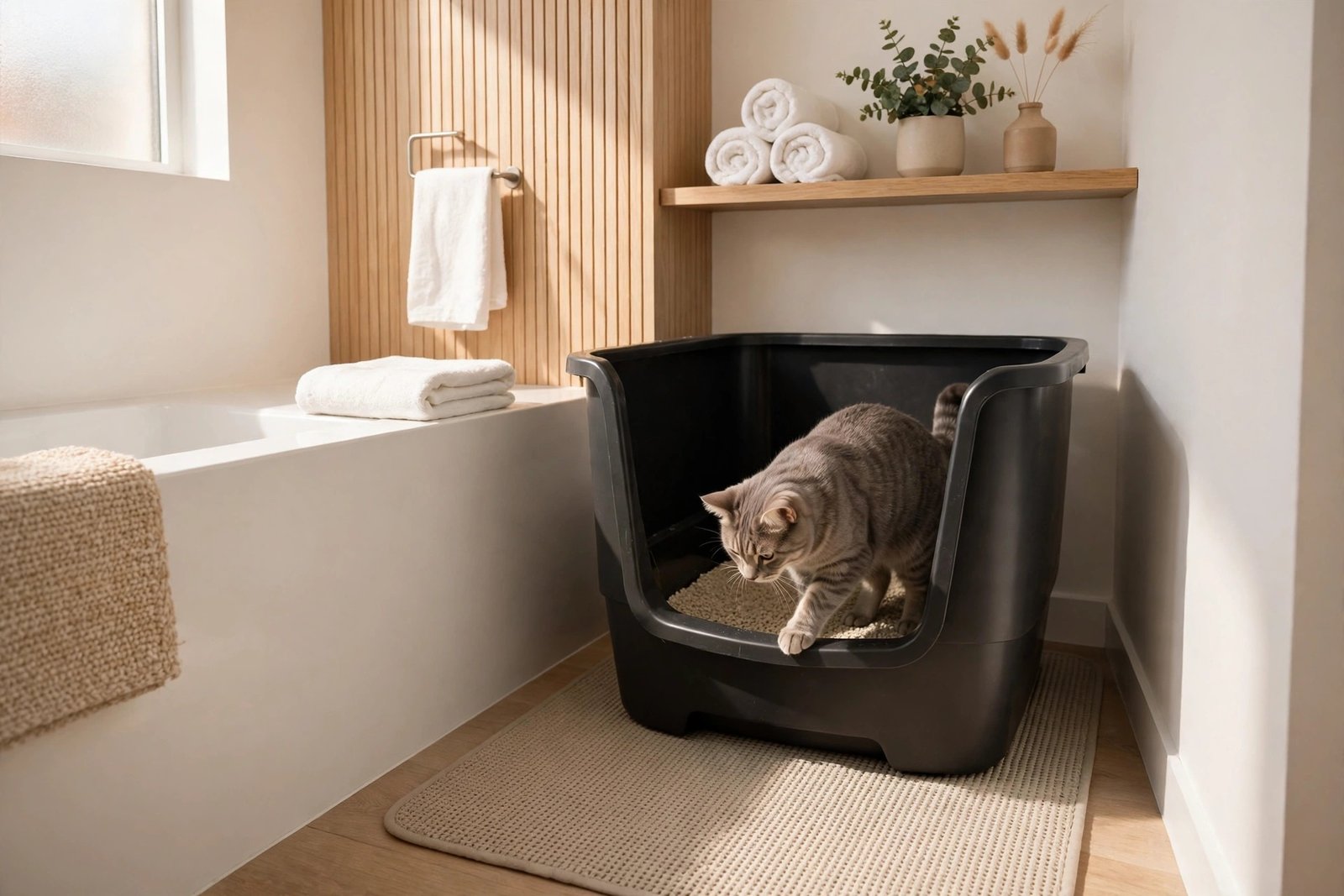
In a small apartment, the litter box has nowhere to hide. It shares your bathroom, competes with your laundry corner, and somehow ends up near the one spot guests walk past. The good news is that a small space does not mean a smelly, messy home. With the right box style, a smart location, and a few simple habits, even a studio flat can have a litter setup that your cat loves and you barely notice. This guide walks through the choices that matter, in the order to make them: box first, then place, then routine.
Everything here is general buying and setup guidance — types, sizes, and materials explained plainly, so you can judge any product against it.
Quick Answer
For a small apartment, choose the largest box that fits your chosen spot — at least one and a half times your cat’s length — in a style that suits the location: an open box with high sides for ventilation, a covered box where privacy matters, or furniture-style enclosures where the box must live in a room you use. Place it in a quiet, always-accessible corner away from food, give the exit a good litter-trapping mat, scoop daily, and wash the box regularly. Space tricks help, but size, location, and routine are what actually keep a small home fresh.
Start With the Box: Types and Trade-Offs
Open boxes with high sides
The simplest and, for many cats, the best. An open box lets odours disperse instead of concentrating, gives the cat a clear view of the room (cats feel safer when they can see), and is easy to scoop. Look for high sides with one lower entry side: the high walls contain the digging while the low side suits kittens, seniors, and stiff joints. If your cat is an enthusiastic digger, our guide on a cat kicking litter everywhere shows how side height and box size tame the mess.
Covered and top-entry boxes
A hood hides the contents and contains scatter, and works well in a hallway or living area — but it also traps smell inside, which your cat notices far more than you do. Some cats dislike feeling enclosed with only one exit. If you choose a covered box, clean it more often, not less, and keep the entrance facing open space. Top-entry boxes save floor space and stop dogs investigating, but they suit only confident, agile cats; skip them for kittens, seniors, or any cat with joint trouble.
Furniture-style enclosures
Cabinets and bench-style enclosures that hide a standard box inside earn their keep in studios and living rooms: the box disappears, the top surface becomes useful, and the enclosure muffles scatter. Two rules make them work: the inside must fit a genuinely big box (measure the interior, not the furniture), and there must be ventilation and an entrance your cat can use in the dark without squeezing. Never let looks shrink the box itself — the cat lives with the inside, guests only see the outside.
Size and material basics
Whichever style you choose: the box should be at least 1.5 times your cat’s body length so she can turn and dig comfortably, made of smooth, non-porous plastic that does not hold odour in scratches. Replace a box whose plastic has become rough and stained — for why and when, see our guide on how to clean a litter box properly. In a small home a slightly larger box usually beats a tiny one, because a cramped cat kicks more litter out and may start avoiding it.

How Many Boxes Does a Small Apartment Need?
The usual rule — one box per cat, plus one spare — still applies in small homes, and it matters more, not less, when one box is your cat’s only option and it gets dirty while you are out. Our full guide on how many litter boxes you need explains the rule and the exceptions. In practice, one-cat studios often manage beautifully with one excellent box in the right spot, scooped twice a day; two cats in a small flat do far better with two boxes in different corners than with one shared box, however large. If space truly forces one box for two cats, size up, scoop morning and evening, and watch for tension around it.
Placement: The Five Rules for Small Spaces
- Quiet but not forgotten: a low-traffic corner your cat can reach at 3 a.m. without crossing the dog, the robot vacuum dock, or a door that gets shut at night.
- Away from food and water: cats strongly prefer distance between eating and toileting; in a studio, opposite ends of the room count.
- Ventilation helps: near (not under) a window or an extractor-fan bathroom keeps air moving; avoid sealed cupboards with no airflow.
- One-way-in safety: the cat should be able to leave by more than one route, or at least never be cornered in the box by another pet or a startled toddler.
- Same spot, always: in a small home, consistency matters — moving the box around a studio confuses the routine that keeps accidents away.
Classic small-apartment spots that work: the bathroom corner beside (not behind) the toilet, the laundry nook, the end of a hallway on a mat, and inside a ventilated enclosure in the living room. Avoid the kitchen if you possibly can, and avoid placing the box directly against a washing machine that will buzz mid-use and teach your cat the spot is alarming.

The Exit Path: Mats and Litter Choices
Most litter ends up outside the box on paws, along the exit path. A large litter-trapping mat — the textured, double-layer or deep-grooved kind that catches granules as the cat walks — under and in front of the box is the single best small-space upgrade: it should extend at least a full cat-length beyond the entrance so every departing paw lands on it. Shake it back into the box or bin daily.
For litter itself in small homes: a clumping litter makes daily scooping fast and complete, which is the real odour control; low-dust formulas keep small rooms and your lungs happier; and unscented or lightly scented types are safer bets, because a perfume that pleases you in a tiny flat can overwhelm a cat’s nose at box level and put her off using it. Whatever you choose, keep the depth around 5–7 cm so digging satisfies without excavating.
Odour Control Is a Routine, Not a Product
In a small apartment there is no “down the hall” for smells to go to, so habits do the heavy lifting:
- Scoop daily — twice daily in studios. Nothing else on this list matters if this one slips.
- Top up, wash weekly-ish, deep clean regularly with mild, unscented cleaning, following the daily/weekly/deep-clean rhythm in our cleaning guide linked above.
- Seal the waste: a small lidded bin or sealed bags beside the box, emptied often, stops the “scooped but still smelly” problem.
- Ventilate daily: ten minutes of open window does more than any scented spray.
If the box still smells despite a good routine, the cause is usually the box itself (old, scratched plastic), too-shallow litter, or a hidden accident spot nearby that needs a proper clean-out — check under and behind the box and along the exit path first, because in small rooms the problem is often beside the box rather than in it.
Mistakes to Avoid
- Do not buy the smallest box to save space. A too-small box creates mess, avoidance, and accidents that cost far more room and patience than a bigger box ever would.
- Do not hide the box somewhere your cat finds stressful — next to a noisy appliance, behind a door that closes, or in a spot she must pass another pet to reach — just because it is out of your sight.
- Do not rely on strongly scented litter, sprays, or plug-ins to cover odour in a small home. To a cat’s nose they can make the box area repellent, and they mask a cleaning problem instead of solving it.
- Do not line the box with plastic liners to save washing time if your cat digs: claws shred them, urine pools underneath, and odour gets worse.
- Do not place the only box in the bathroom and then shut the cat out of it all night or while guests use it. Access is part of the setup.
Frequently Asked Questions
Is a covered litter box better for a small apartment?
It is better for your eyes, not automatically for your cat or for odour. A hood contains scatter and hides waste, but traps smell where the cat stands, so covered boxes need more frequent scooping and washing, not less. Many cats prefer open boxes with high sides, which ventilate naturally. A good compromise in living areas is a furniture-style enclosure with a full-size open box inside it.
Where is the best place for a litter box in a studio flat?
The bathroom corner is the classic answer: tiled floor, extractor fan, easy cleaning. If the bathroom is tiny or the door must stay shut, a ventilated enclosure at the far end of the living area from the kitchen, on a large mat, works well. Keep it away from the bed head and the food area, keep the route open all night, and do not move it once your cat has accepted it.
Can one litter box work for two cats in a small flat?
Sometimes, but it is the exception rather than the plan. Two cats sharing one box need it large, scooped at least twice a day, and watched for guarding or queueing tension. Most pairs do noticeably better — cleaner habits, less stress — with two modest boxes in different corners. If one cat starts toileting elsewhere, treat it as the setup asking for a second box, not as naughtiness.
How do I stop litter tracking through the whole flat?
Attack the exit path: a big textured trapping mat extending well beyond the entrance, box sides high enough to slow the leap out, litter depth around 5–7 cm, and a quick daily shake of the mat back into the bin. A low-sided “landing zone” rug beyond the mat catches the last granules before hard floors spread them. Tracking never reaches zero with a digging cat, but this combination gets it close.
