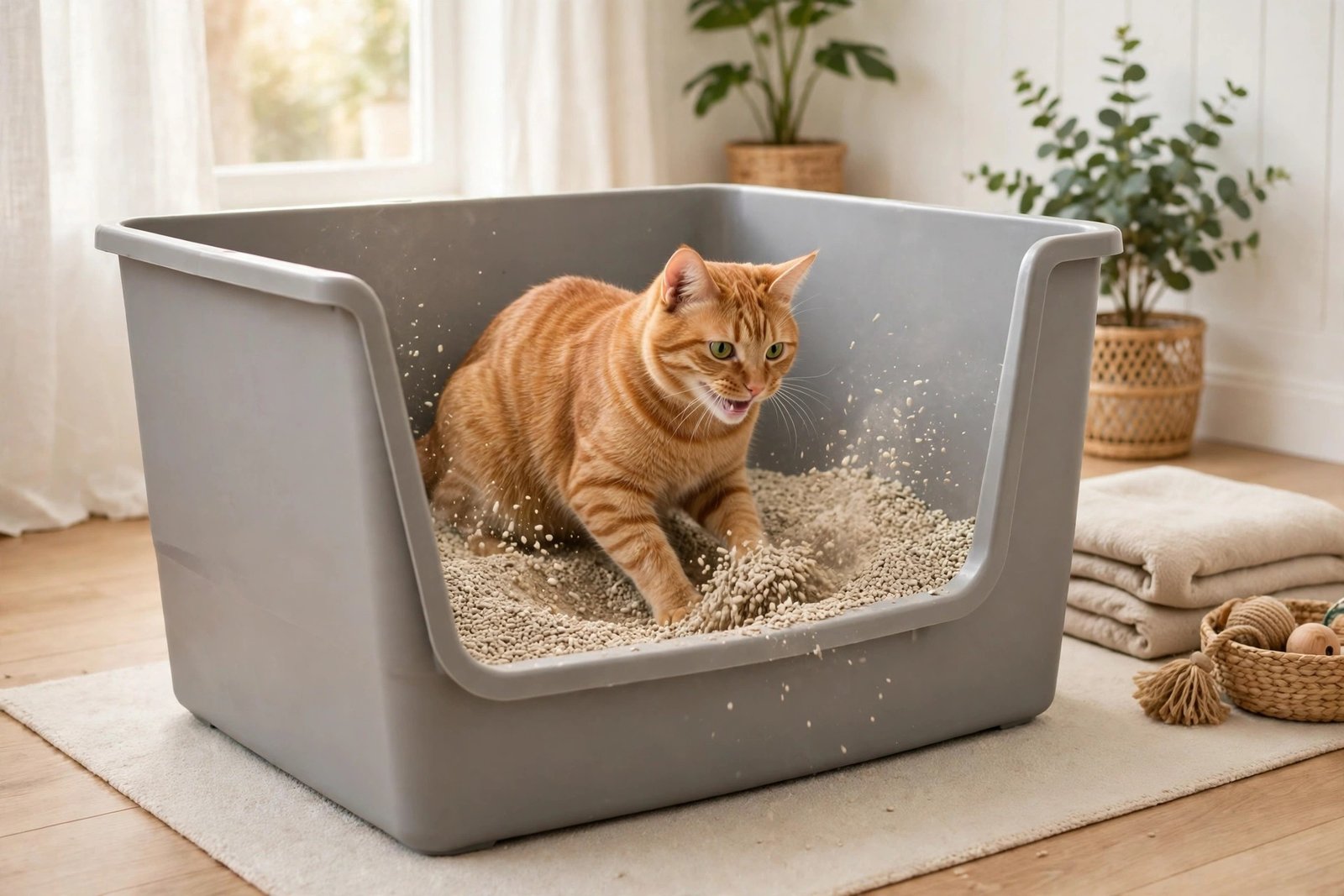
There is litter on the mat. There is litter across the bathroom floor, tracked down the hallway, and somehow, defying physics, in the bed. If your cat exits the litter box like she is launching a small gravel explosion, you are dealing with one of the most universal, and most fixable, annoyances of indoor cat life. Some of it is simply how cats are built. The rest is a set of small, practical things about the box, the litter, and the floor around it that you can genuinely change.
This guide splits the problem into its three parts: the enthusiastic digging that throws litter inside the box, the dramatic exit that flings it outside, and the paw-tracking that carries it through the house. Each part has its own fixes, and most homes see a dramatic improvement from just two or three of them.
Quick Answer
Cats kick litter because digging and burying are hard-wired instincts, so the goal is containment, not stopping the behaviour. The fixes that work best: a bigger box with higher sides (or a top-entry or covered design), litter kept at about 5 to 7 cm deep, a large textured litter mat that fills the exit path, and a quick daily sweep or vacuum around the box. Tracking through the house drops sharply with a mat big enough that every exit path crosses several steps of it, and with a heavier, low-dust litter that does not cling to paws.
Why Cats Kick Litter in the First Place
Burying waste is instinct. Outdoors, it hides scent from predators and rivals, and indoor cats run the same programme on two inches of litter in a plastic tray. Some cats are minimalists: one scrape, done. Others are perfectionists who dig before, excavate during, and landscape extensively afterwards, and breed, age, and personality all play a part. Kittens often dig for the sheer joy of it, and some cats scratch at the walls and floor around the box too, burying in spirit long after the litter gives out; if the digging happens with real energy at night, our guide on a cat scratching the litter box walls at night covers that pattern and how to quiet it.
The important mindset shift: your cat is not being messy on purpose, and she cannot be trained out of an instinct. Everything below is about making the mess land where it is easy to deal with.
Fix the Box: Size, Sides, and Style
- Go bigger: a box that is too small concentrates every dig in a few centimetres from the edge, so each stroke ejects litter. A box around one and a half times your cat’s length gives the digging room to happen in the middle, where the litter stays. This single change solves more kicking than any other.
- Higher sides: litter flies at digging height. Boxes with raised sides, especially at the back where most cats dig, catch what a shallow tray cannot. Add a low entry cut-out or step if your cat is a kitten, senior, or stiff in the joints.
- Top-entry boxes: these contain virtually all digging spray, and litter on the lid falls back in when the cat exits. Most cats adapt quickly, but introduce one alongside the old box rather than swapping overnight.
- Covered boxes: a hood contains scatter well. Some cats love the privacy; others dislike the enclosed smell, so a covered box only counts as a win if the cat uses it happily. If a hood makes things worse, remove it and rely on high sides instead. And if your cat has started avoiding the box altogether at any point, treat that as the bigger problem first; our guide on a cat not using the litter box works through the causes in order.
- Watch numbers and placement: a cat hurrying because another cat is waiting, or because the box sits in a busy corridor, exits in a rush and scatters more. Enough boxes, in calm spots, produce calmer, tidier exits; the usual rule of thumb, one box per cat plus one spare, applies here too.
Fix the Litter: Depth and Type
Depth is a dial, not a guess
Around 5 to 7 cm is the sweet spot for most cats. Too shallow, and vigorous digging hits the box floor, scrapes loudly, and skids litter outward with every stroke. Too deep, and there is simply more material available to fly, plus some cats dislike the unstable, sinking feeling. If your cat is a champion digger, start at 5 cm rather than 7 and adjust by what you sweep up.
Type matters for tracking
Fine, light litters cling to paws and fur and travel furthest; heavier, larger granules tend to stay nearer the box. Long-haired cats carry more of any litter out between their toes. There is no universal best, only the combination your cat accepts and your floor tolerates, so change gradually: mix increasing amounts of a new litter into the old over a week, because a sudden swap can cause a refusal that no tidy floor is worth. Whatever you choose, keep it clean: a cat picking her way daintily around yesterday’s clumps digs and leaps more dramatically than one stepping into a fresh box, which is why the daily routine in our guide on how to clean a litter box properly quietly reduces scatter too.
Fix the Floor: Mats and the Exit Path
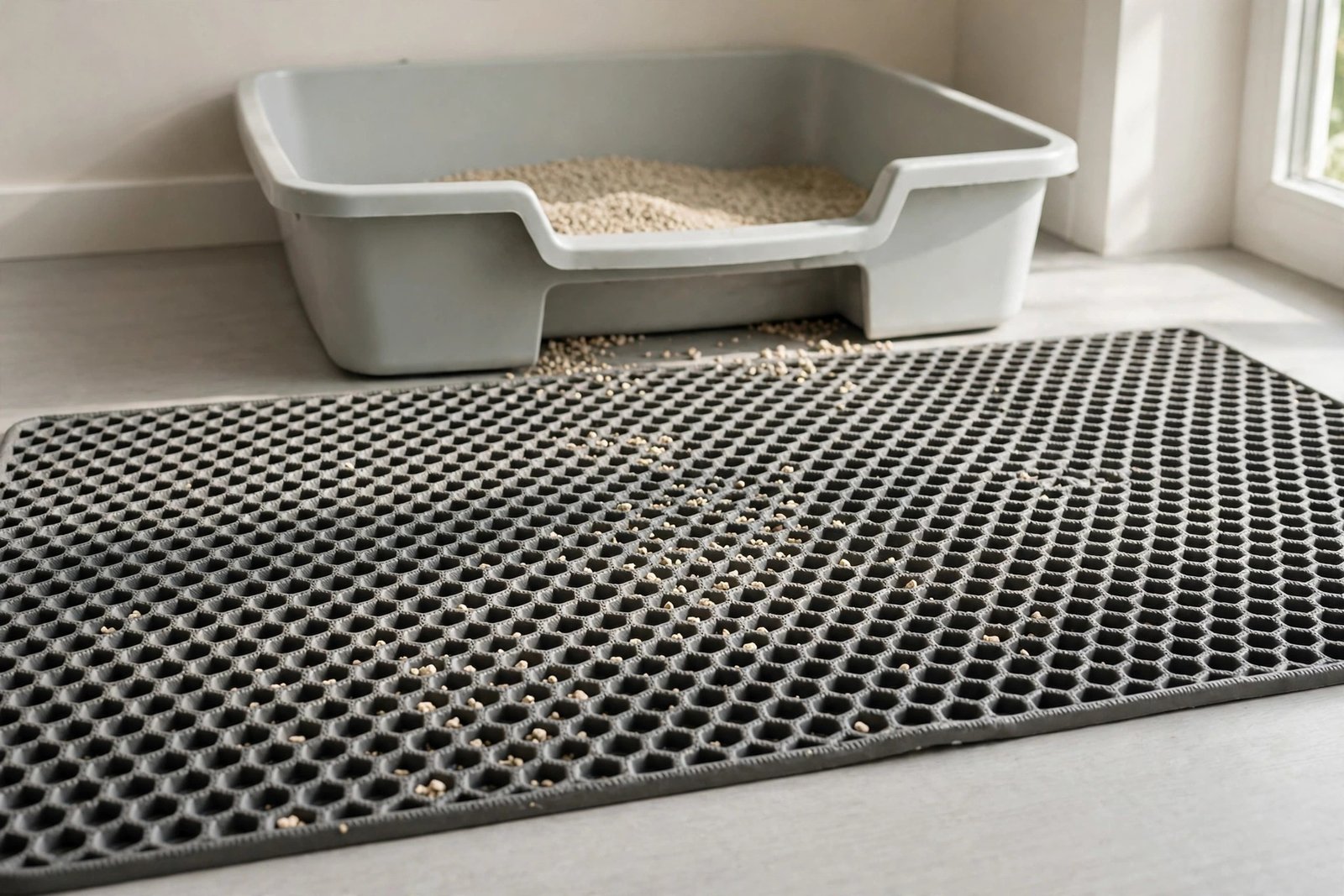
- Size the mat to the exit, not the box: every cat leaves in one or two directions. The mat should extend at least two or three cat-steps, roughly 60 to 90 cm, along those paths, so paws land on it several times before reaching bare floor. A mat the size of a postage stamp in front of the box is decoration.
- Texture does the work: deep-grooved, honeycomb, or looped mats trap granules knocked off paws. Double-layer honeycomb styles let litter fall through to a tray layer you empty back into the box, which also saves litter.
- Put a mat inside the exit too: for open boxes, a washable mat or piece of low-pile carpet just outside, plus a quick daily shake into the bin, keeps the perimeter civilised.
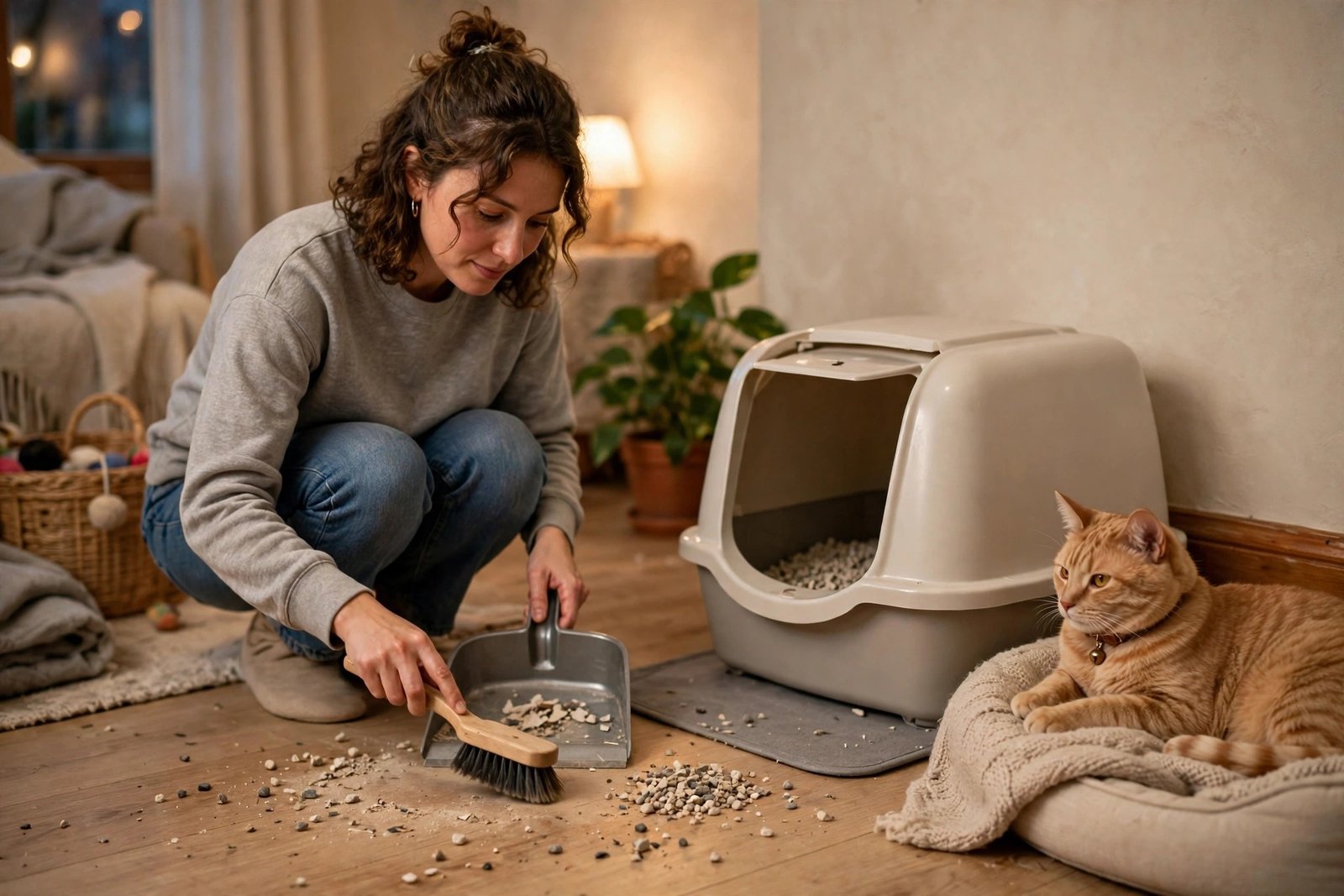
- Make sweeping effortless: a small hand brush or a lightweight stick vacuum living beside the box turns a 30-second daily sweep into a non-event. Litter on hard floors also migrates on socks and slippers, so the sweep matters more than it looks.
Mistakes to Avoid
- Trying to stop the digging itself: scolding, startling, or hovering to correct her mid-dig only adds stress around the box, and stress around the box is how real litter problems start. Contain the mess; never punish the instinct.
- Cutting the litter to a sprinkle to reduce scatter: too-shallow litter fails at its actual job, smells faster, and makes many cats dig even harder. It trades a sweeping problem for a smell problem.
- Changing everything at once: new box, new litter, new room, new mat, all in a weekend. If she objects, you will not know to what. One change at a time, each given a few days, keeps the cat on board.
- Choosing a covered box to hide an unclean one: hoods trap smell in as well as litter. A covered box needs the same daily scooping as any other, or the cat pays for the tidiness with a grim toilet.
- Placing the box on carpet without protection: litter grinds into carpet pile and is miserable to extract. A washable waterproof layer under and around the box saves the floor entirely.
Frequently Asked Questions
Why does my cat kick litter out right after I have cleaned the box?
Fresh litter is the most inviting to dig in, and a full-depth refill gives her the most material to work with. Refill to the shallower end of the range, around 5 cm, if the post-clean explosion is your main issue.
Do high-sided boxes work for kittens and older cats?
Yes, if entry stays easy. Choose a high-sided box with one lowered entry side, or add a small step or ramp. If a senior cat starts avoiding a high box, joints may be the issue, and a low entry matters more than containment.
How do I stop litter tracking through the whole house?
Attack it in order: a large textured mat covering several steps of the exit path, a heavier litter that clings less, and a daily 30-second sweep or vacuum by the box. Together these usually cut tracking to a small zone near the box.
My cat scratches the floor around the box instead of the litter. Why?
She is running the burying programme on the wrong surface, often because the litter feels too shallow, too dirty, or simply not to her taste, or because the box is too small to manoeuvre in. Check depth and cleanliness first, then box size, before assuming it is just a quirk.
A house with a cat will never be a zero-litter house, and that is fine. A big enough box, the right depth, and a mat that means business shrink the problem to one small, sweepable corner, and your digger gets to keep the instinct she was born with.
1 thought on “Cat Kicking Litter Everywhere? Mats, Box Fixes and Easy Clean-Up Habits”