
One cat is guarding the hallway. The other is living under the bed. Meals end in staring matches, the litter box has become a battleground, and the peaceful home you imagined with two cats feels a long way off. If your cats are not getting along, you are not alone, and it does not mean you have failed them. Cat conflict is one of the most common multi-cat problems, and in most homes it improves — often a lot — with space, separation, and a slow, calm reset.
This guide explains how to read the tension early, how to separate resources so neither cat has to compete, and how a step-by-step re-introduction gives both cats a fair chance to relax around each other again.
Quick Answer
Most cat conflict is about resources and territory, not hatred. The fix is to remove competition: give each cat her own feeding spot, litter box, water, and resting places in separate areas, then rebuild the relationship slowly with scent swapping, feeding on opposite sides of a closed door, short supervised time together, and play and treats that make the other cat predict good things. Never punish either cat, and never hold them together or force meetings. If there are injuries, or a cat is hiding constantly and not eating, involve your vet or a qualified behaviour professional.
First: What Cat Conflict Really Looks Like
Out-and-out fights are the obvious sign, but most tension is quieter. Cats are masters of the silent dispute, and owners often miss the early stages because nobody is making any noise.
- Staring and blocking: one cat sits in a doorway or on the route to the litter box, staring. The other cat “suddenly” stops using that room. This is guarding, and it is serious even though it looks like nothing.
- The chase that is not play: in play, cats take turns chasing and stay silent. In conflict, the same cat always flees, there may be hissing, and the fleeing cat hides afterwards.
- Hiding and lifestyle shrinkage: a cat who now lives in one room, comes out only at night, or waits until the other cat is asleep to eat is a cat under pressure.
- Litter box problems: one cat ambushes the other at the box, or the nervous cat stops using it. Our guide to a cat not using the litter box covers the box side of this in detail.
- Over-grooming, appetite changes, or sleeping much more in the cat who is losing the quiet battles. A cat who suddenly seems to sleep all day may be avoiding someone, not resting — our article on a cat sleeping all day helps you tell the difference.

Step One: Separate the Resources
Before any introductions, remove the reasons to compete. A cat who can eat, drink, toilet, and rest without meeting the other cat is a cat whose stress drops — and lower stress is what makes peace possible.
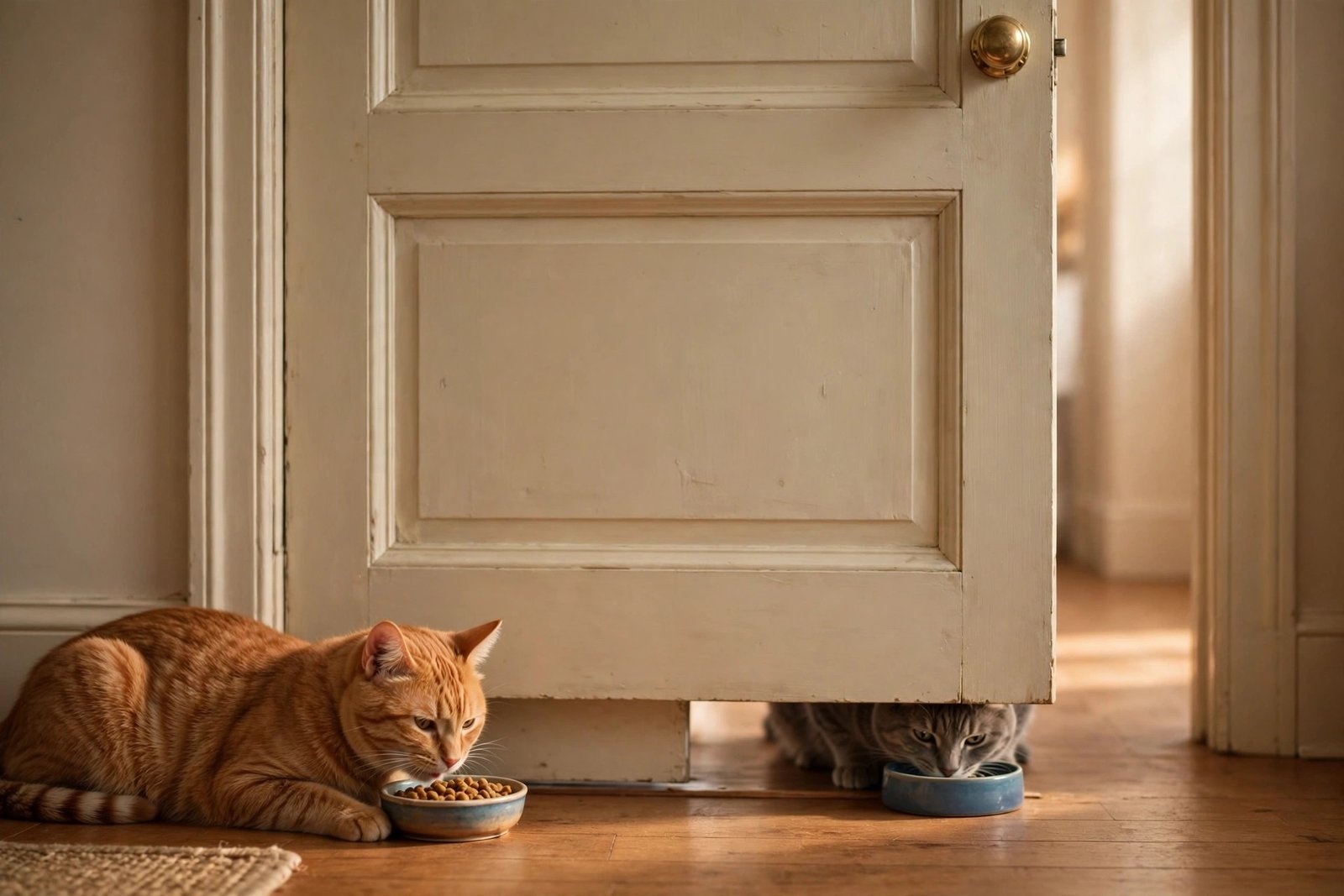
- Food: feed in completely separate spots, ideally different rooms with the door closed. Remove bowls afterwards so mealtimes have a clear end.
- Litter boxes: at least one per cat plus one spare, in different locations — never side by side in one corner. Our guide on how many litter boxes you need explains the rule and placements.
- Water: bowls in more than one place, away from food if your cats prefer it.
- Resting and hiding places: each cat needs a spot that is truly hers — a bed, a box, a perch — in her own area, plus high routes so a cat can pass through a room without walking a gauntlet on the floor.
- Scratching posts: more than one, in different rooms, so scratching to release tension never starts an argument over a post.
For many mildly tense pairs, resource separation alone changes the whole mood of the house within a week or two, because the daily flashpoints simply stop happening.
Step Two: The Slow Re-Introduction
If there has been a real fight, or one cat is frightened, do a proper reset. It feels like going backwards, but a clean restart works far better than hoping they sort it out.
Stage 1: Complete separation with scent swapping
Keep the cats in separate areas with everything they need. Twice a day, gently rub a soft cloth on one cat’s cheeks and then leave it near the other cat’s feeding spot, and swap bedding between them. You are teaching each cat that the other’s scent predicts calm, ordinary life. Swap rooms for an hour or two as well, so each explores the other’s smell with nobody home to defend it.
Stage 2: Meals near the closed door
Feed both cats at the same time on opposite sides of a closed door, starting far enough back that both eat relaxed, and moving the bowls a little closer over days. Eating is the strongest positive experience you can pair with the other cat’s presence. If one cat will not eat, the bowls are too close — move them back and slow down.
Stage 3: Seeing without touching
Move to a slightly open door with a secure barrier, or a tall baby gate with a towel over the top half at first. Short sessions, with treats and gentle play on both sides. Watch for relaxed bodies, blinking, and interest in the food or toy rather than fixation on the cat. End sessions while things are still calm.
Stage 4: Short supervised time together
Open the barrier for brief, boring visits in a room with escape routes and high perches. Keep two wand toys moving so the cats play near each other rather than at each other, feed a few treats, and finish before tension builds. Several short, dull sessions are worth far more than one long dramatic one. If a stare hardens, calmly distract with a toy or tossed treat and end the session — no scolding, no drama.
Most pairs take two to six weeks through these stages. Some take longer, and a few cats settle into a “separate floors, polite distance” arrangement instead of friendship. That is a success too: the goal is a calm home, not a cuddle photo.
Reading Tension Early: Your Daily Job
During and after re-introduction, you are the referee who never touches the players — you change the environment instead. Watch for a fixed stare, a slowly lashing tail, ears rotating back, one cat deliberately crossing to block a route, or either cat’s world shrinking again. Any of these means: add more separation, more resources, and go back one stage for a few days. Progress with cats is a staircase, not a slope, and stepping down one stair is maintenance, not failure.
When to Get Professional Help
Contact your vet first if there are injuries of any kind, if a cat stops eating, hides almost constantly, or starts toileting outside the box, or if the conflict began suddenly in cats who previously got along — sudden behaviour change can have a medical cause, such as pain, and a physical check comes before behaviour work. The vet may refer you to a qualified behaviour professional for a tailored plan, and that is a strength, not a last resort. This article is general information only and is not veterinary or behaviour advice for your specific cats.
Mistakes to Avoid
- Never punish, spray, shout at, or scruff either cat for fighting or staring. Punishment raises stress, and stress is the fuel of the whole problem; it also teaches cats to associate each other with bad things happening.
- Do not hold the cats facing each other, carry one to the other, or “let them work it out” through a real fight. One bad fight can set a relationship back months.
- Do not put food bowls or litter boxes side by side to encourage sharing. To a cat, that is not sharing — it is competition with a witness.
- Do not rush the stages because three days went well. Calm behaviour near a door is learned in days; trust is learned in weeks.
- Do not favour the “victim” with comfort while the other watches, or exile the “bully” as a villain. Both cats are stressed; both need their own resources, play, and calm attention.
Frequently Asked Questions
How long does it take for two cats to get along?
For a mild tension reset, many homes see real improvement in two to six weeks of separation plus staged re-introduction. Newly introduced adult cats can take two to three months to settle into an easy routine. Judge progress by shrinking worlds expanding again — the nervous cat eating in the open, using all the rooms, relaxing in shared spaces — rather than by whether they cuddle.
Should I separate my cats after every fight?
After any fight with chasing, screaming, fur flying, or injury, yes: calmly separate them (a tossed cushion landing nearby or a blanket over one cat breaks focus safely; never reach in with your hands), let everyone cool down for at least 24 hours, and restart one stage back in the re-introduction plan. A brief hiss during a staged session, with both cats then relaxing, is information, not a failure — just end the session and try again tomorrow.
My cats were fine for years and suddenly fight. Why?
Sudden conflict in established pairs has a trigger: a vet visit that made one cat smell strange, a strange cat at the window that redirected frustration onto the housemate, a house move, a new pet or person, or pain or illness in one cat. Book a vet check for both, think back over what changed, and run the same separation and re-introduction steps — pairs who once got along usually come back faster than strangers.
Will getting a third cat help?
Almost never. Adding a cat to a tense home adds a third competitor for the same resources and gives both existing cats a new source of stress. Fix the current relationship and resources first. If you adopt later, do it from a position of calm, with space and boxes to spare.
