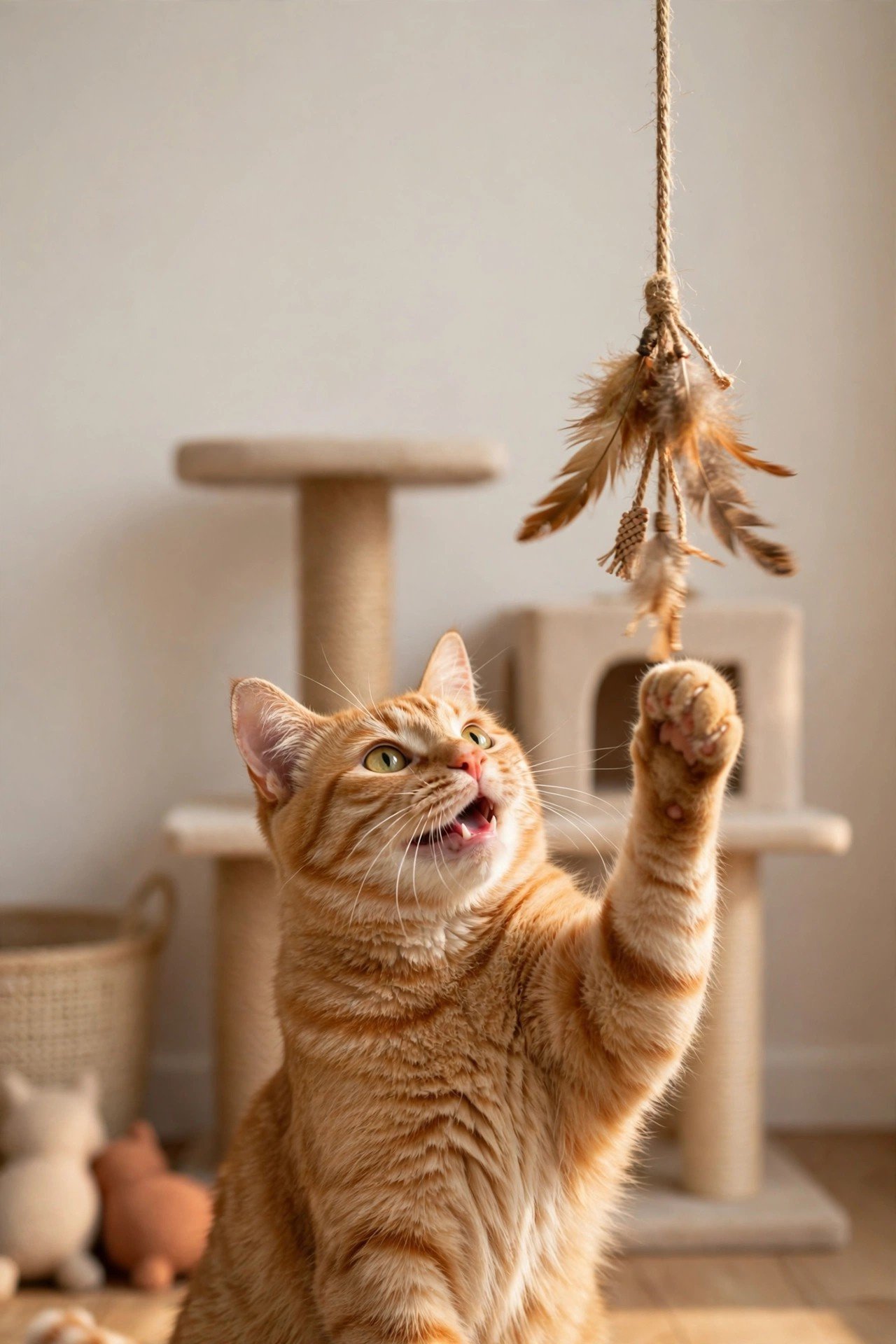
Indoor cats live safer, longer lives than cats who roam — but an indoor life asks something in return. A cat’s brain is built to hunt, climb, explore, and solve small problems every day, and a quiet flat offers few of those by default. When the hunting and exploring do not happen, the energy and instinct do not disappear; they leak out as behaviours owners find puzzling or frustrating. The good news is that boredom is one of the most fixable problems in cat care, and the fixes are mostly simple, cheap, and fun.
This guide walks through nine common signs of a bored indoor cat, how to tell boredom from a health problem, and the enrichment changes — a window perch, rotated toys, a play routine, and food puzzles — that make the biggest difference.
Quick Answer
A bored indoor cat often shows it through behaviour, not laziness: over-grooming, waking the house at night, attacking ankles, begging for food, destroying or knocking things over, and sleeping far more — or far worse — than usual. The answer is environmental enrichment: daily interactive play that mimics hunting, a window view, toys rotated so they stay interesting, and food puzzles that make your cat work a little for meals. Most cats brighten noticeably within two weeks. One caution: over-grooming and appetite changes can also be medical, so if those signs persist after enrichment, see your vet.
Nine Signs Your Indoor Cat Is Bored
1. Over-grooming
A bored or under-stimulated cat may lick and groom far beyond normal coat care, sometimes thinning the fur on the belly, legs, or flanks. Grooming is self-soothing — it fills empty time the way we scroll a phone. Because skin problems and pain cause the same sign, treat over-grooming as “enrich first, vet if it persists,” never as boredom alone.
2. Night-time noise and racing around
A cat who sleeps through a long, empty day is wide awake and full of fuel at 3 a.m. Yowling tours of the house, galloping down hallways, and pouncing on sleeping owners are classic signs the day did not use up the cat. If this sounds familiar, our guide to cat zoomies at 3 a.m. lays out the evening routine that fixes it.
3. Ankle attacks and ambushes
Hunting practice has to go somewhere. A bored cat stalks the only moving “prey” available — your feet. Ambushes from behind furniture and grabs at passing ankles are usually under-played cats, not aggressive ones; our article on why cats attack ankles explains how to redirect the hunt onto toys.
4. Constant food begging and overeating
For a bored cat, the food bowl is the most exciting event in the house. Meowing at the kitchen, waking you for breakfast earlier and earlier, and eating fast then asking again often mean the day needs more events, not more calories. Overeating quietly leads to weight gain, which then makes play harder — a cycle worth breaking early.
5. Sleeping much more than usual — or restlessly
Cats sleep a lot by nature, but a bored cat’s sleep changes character: longer, flatter, harder to rouse for play, and with little of the alert, curious waking time in between. Some bored cats show the opposite — broken, restless sleep with frequent night waking. Either change from your cat’s normal pattern is information.
6. Destructive play and object pushing
Unravelling toilet rolls, chewing plants or cables, and sweeping objects off tables are often a cat manufacturing her own entertainment. She is not naughty; she is underemployed. (Plants and cables do need managing for safety — move toxic plants out of reach entirely.)
7. Attention demanding
Following you from room to room, sitting on your keyboard, meowing at closed doors, and demanding fuss the moment you sit down can all be a cat asking for the interaction her day lacks. Some of this is normal affection; a sharp increase is a boredom clue. Door-focused meowing has its own pattern, covered in our guide to cats meowing at closed doors.
8. Irritability and short fuse
A chronically bored cat is often a grumpier cat: swatting at the other household cat, hissing at handling she used to accept, or lashing a tail through interactions that were fine before. Frustration lowers tolerance for everything.
9. Loss of interest in play
The paradoxical late sign: a cat who has been bored for a long time may stop trying. She ignores new toys, watches play half-heartedly, and seems “lazy.” This is learned helplessness, not contentment, and it responds to gentle, daily, short play sessions that rebuild the habit of fun.
First, Rule Out Health
Boredom is a common explanation, but it is not the only one. Over-grooming can mean allergies, skin disease, or pain. Appetite changes can signal anything from dental pain to thyroid trouble. Sudden sleep or behaviour change in an older cat deserves a vet visit before a behaviour plan. The rule of thumb: enrich the environment for two weeks; if over-grooming, appetite change, or any worrying sign persists or worsens, see the vet. Enrichment is never wasted — but it should never delay medical care either.
The Fixes That Work
A daily play routine
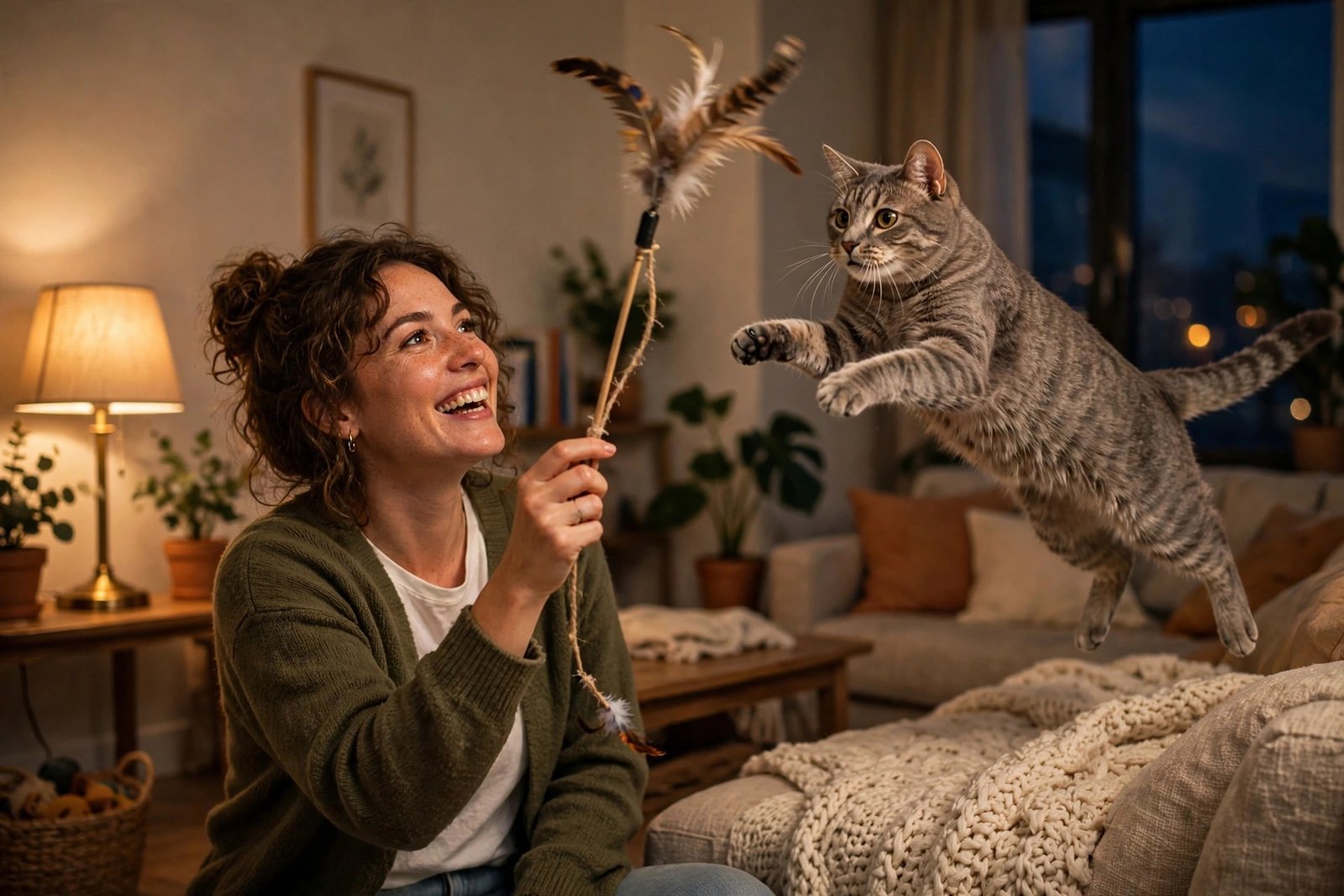
The single most powerful change. Two sessions of ten to fifteen minutes with a wand toy, ideally morning and evening, following the hunt pattern: stalk, chase, catch, and then a small meal or treat to complete the cycle. The evening session, finished with supper, is what buys you a quiet night.
A window on the world
A sturdy perch or cleared shelf by a window gives a cat hours of safe “cat television” — birds, weather, street life. A bird feeder outside the glass doubles the entertainment. Vertical space in general — a tall cat tree, shelves, the top of a wardrobe made accessible — expands her territory without expanding your floor plan.
Rotate the toys
A toy that lives on the floor for a month becomes furniture. Keep most toys in a drawer, put out three or four, and swap them every few days; the returning toys are interesting again. Mix types: things that roll, things that crinkle, things that fly on a wand, and something soft to bunny-kick.
Food puzzles and scatter feeding
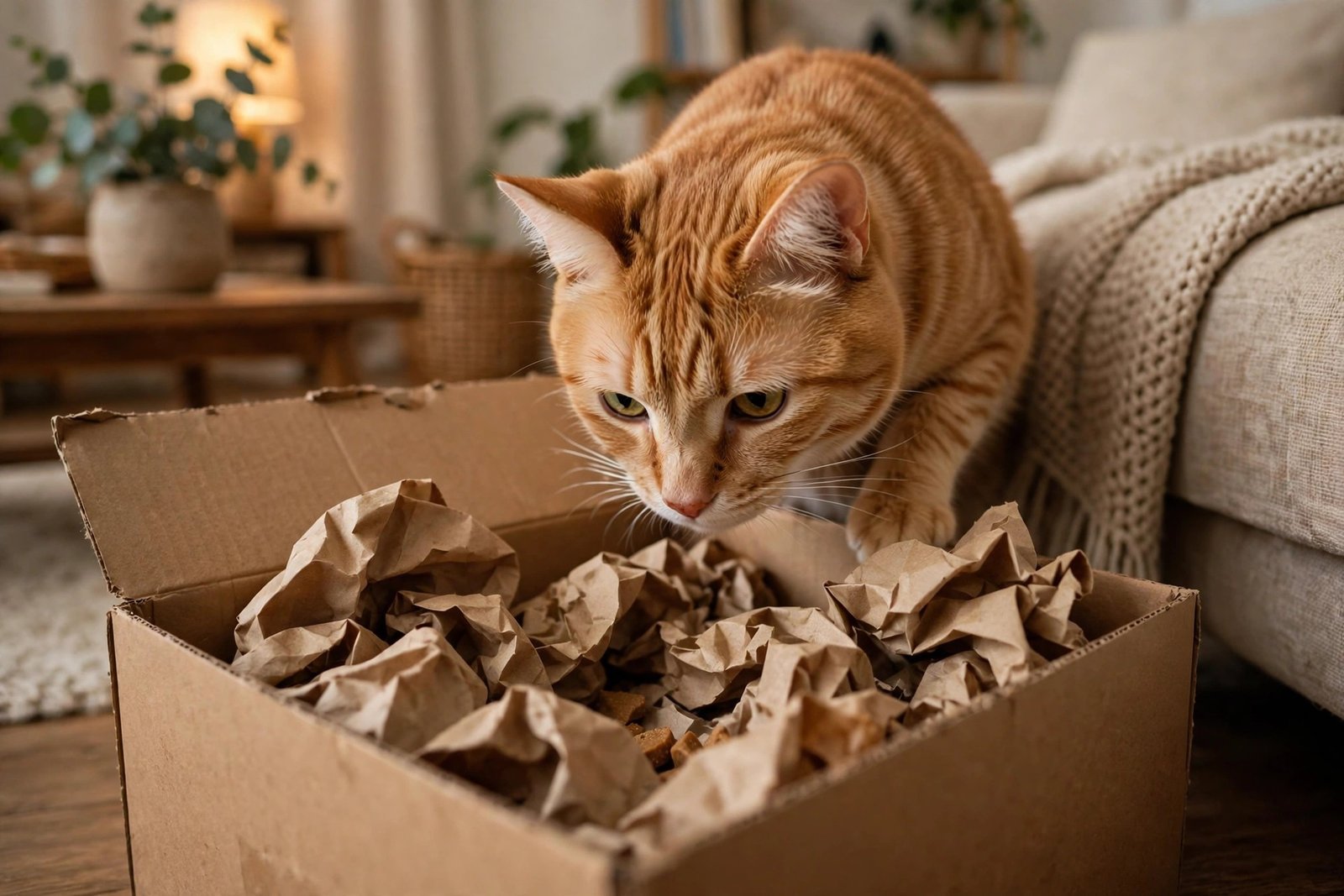
Make meals take effort. Start with an easy food puzzle or treats scattered in a cardboard box of scrunched paper, and raise the difficulty as she learns. Even feeding one meal a day from a puzzle instead of a bowl adds real work — and real satisfaction — to an indoor cat’s day. No special products are required; homemade versions work well.
Small daily novelties
A cardboard box left out for two days, a paper bag (handles removed), a supervised sniff of a new herb like cat grass, a few minutes of clicker-style training for treats — tiny novelties keep an indoor world feeling alive. Training games in particular exhaust the brain pleasantly, and most cats adore them.
Mistakes to Avoid
- Never punish, spray, shout at, or scare a bored cat for bored behaviour. Night noise, ankle grabs, and over-grooming are symptoms of an unmet need. Punishment adds stress to boredom and reliably makes the behaviour worse.
- Do not solve food begging with more food. Feed measured meals, move the excitement into puzzles, and let the vet guide any weight plan.
- Do not buy twenty toys and dump them all out at once. Rotation, not quantity, keeps toys interesting.
- Do not assume a quiet cat is a content cat. Withdrawn, flat behaviour can be the deepest boredom — or illness. Watch for change, and ask the vet when unsure.
- Do not expect one big weekend play session to cover the week. Cats need small daily doses of hunting and novelty; routine beats intensity.
Frequently Asked Questions
How much play does an indoor cat actually need?
Most indoor cats thrive on two interactive play sessions a day of about ten to fifteen minutes each, adjusted for age and health — kittens often want more, seniors less but still some, in gentler form. Add passive enrichment (window perch, puzzles, rotating toys) and you cover a typical cat’s needs well. Quality matters: play that mimics a hunt beats vaguely waving a toy while watching television.
Is my cat bored or depressed?
The signs overlap, and “depression” in cats usually has a cause worth finding — grief after losing a companion, pain, illness, or a major household change. If your cat has withdrawn, stopped eating properly, or changed suddenly, see the vet first to rule out medical causes. If she is healthy, the enrichment plan in this article is the right next step; a bored cat brightens as the days fill up.
Do indoor cats really need a window perch?
It is one of the highest-value, lowest-effort enrichments you can offer. Watching the outside world gives an indoor cat changing sights, sounds through the glass, and sunlight to nap in — hours of gentle stimulation every day with no effort from you after setup. A cleared windowsill with a cushion works fine; it does not need to be a special product.
How soon will enrichment improve my cat’s behaviour?
Many owners notice better nights within the first week of an evening play-and-feed routine. Attention-seeking and destructive habits usually soften over two to three weeks of consistent play, puzzles, and rotation. If a sign like over-grooming or appetite change has not improved by then, that is your cue to involve the vet rather than simply trying harder at home.