
Few things sting quite like watching your cat stretch up, dig her claws into the arm of your best sofa, and pull down with obvious pleasure — especially if the sofa was expensive. It is easy to feel that she is doing it deliberately, or that she is badly behaved. She is neither. Scratching is one of the most basic and necessary cat behaviours, and the sofa is simply winning a competition you did not know was happening. The way to save your furniture is not to stop the scratching, but to win that competition with a better offer.
This guide explains why cats must scratch, why sofas are such a popular target, and the placement, texture, and cover tricks that move scratching onto posts and pads where it belongs.
Quick Answer
Cats scratch to keep their claws healthy, to stretch their bodies, and to leave scent and visual marks that say “I live here.” A sofa is tall, stable, textured, and usually right next to where the cat sleeps and socialises — which makes it nearly perfect. You will not stop the need, but you can redirect it: put a tall, sturdy scratching post inches from the sofa’s favourite corner, offer the textures cats love, reward every use, and make the sofa itself less appealing with a cover or throw while your cat learns. And never declaw: it is an amputation, it is harmful, and it commonly creates worse problems than scratching.
Why Scratching Is a Need, Not a Habit to Break
A house cat’s claws grow in layers. Scratching pulls off the old, loose outer sheath and keeps the claw beneath sharp, clean, and comfortable. Without regular scratching, sheaths build up and can make walking uncomfortable. Scratching is also a full-body stretch: watch a cat at a tall post and you will see the spine lengthen, the shoulders open, and the back legs push — it is closer to yoga than to vandalism.
There is a third job, too. Cats have scent glands between their toes, so every scratch leaves a personal scent mark, alongside the visible grooves. Together they are a polite notice to other cats: this place is occupied. This is why cats prefer to scratch in prominent, shared places rather than hidden corners — a point that matters a lot when you choose where the post goes.
Why the Sofa Wins
Look at your sofa through your cat’s eyes. It is tall enough for a full stretch. It does not wobble when she pulls. The fabric gives satisfying resistance and shreds into visible marks. And crucially, it sits in the middle of family life, usually right beside where she naps. Many cats scratch within minutes of waking, so the best scratching surface in the house being next to the best sleeping spot is no accident.
If your cat sleeps most of the day on or near that sofa, her scratch-on-waking routine will happen there too; our overview of how much sleep is normal for a cat explains the rest-and-wake cycle that drives this pattern. Any alternative you offer has to beat the sofa on height, stability, texture, and location — or at least match it closely — before your cat will switch.
Step One: Put the Post Where the Problem Is
This is the step most people get wrong. A lovely new post hidden in a spare room will be ignored, while the sofa keeps its role. Instead:
- Place the post directly beside the exact corner or arm your cat already scratches — inches away, not across the room.
- Choose tall and sturdy. For most adult cats that means a post tall enough for a full upright stretch (around 80 cm or more) with a heavy base that cannot tip or slide when she pulls hard.
- Add a second spot near her main sleeping area, because wake-up scratching happens there.
- Once she is using the post reliably for several weeks, you can move it gradually — a small distance each day — towards where you would prefer it to live.
Step Two: Offer the Textures Cats Actually Choose
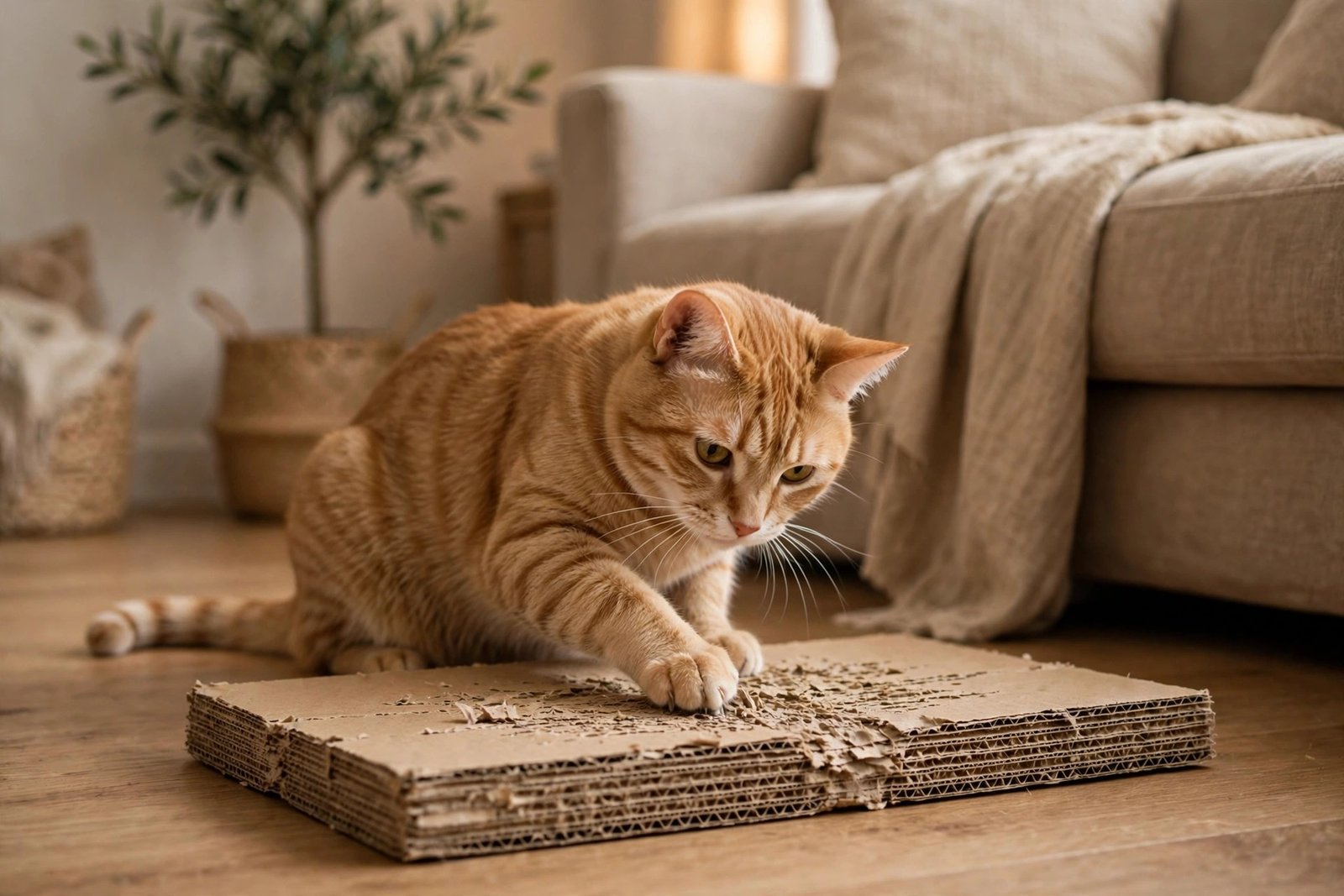
Cats have individual tastes, so offer a small variety rather than betting everything on one post. Sisal rope or sisal fabric wrapped tightly around a post is the most popular choice and the closest legal match to sofa fabric’s shredding satisfaction. Corrugated cardboard, in flat or angled pads, suits cats who prefer to scratch horizontally — many older cats and cats who scratch carpets do. Natural wood and carpet-covered posts each have their fans too.
Orientation matters as much as material. Watch your cat: vertical scratchers need height, horizontal scratchers need pads on the floor, and some cats want both. A home with one of each usually ends the sofa’s career as a scratching surface.
Step Three: Reward the Post, Shrink the Sofa’s Appeal
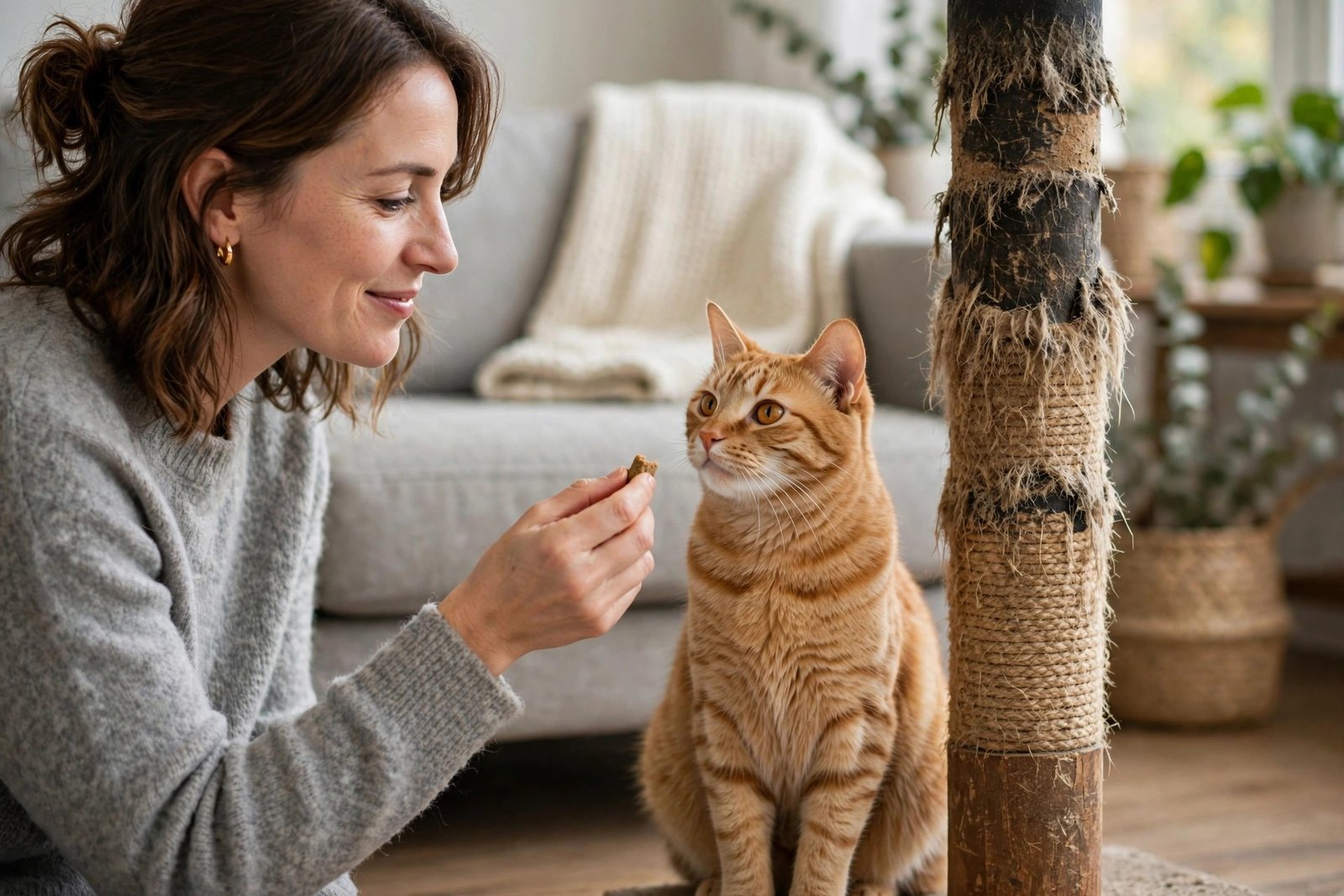
Every time your cat uses the post, mark it: gentle praise, a small treat, or a moment of play. You are building a new habit, and habits grow on rewards. You can also make the post smell inviting by rubbing a little catnip or a favourite blanket on it, if your cat responds to catnip.
At the same time, quietly reduce the sofa’s charm. A snug throw or furniture cover over the favourite corner changes the texture under her claws and protects the fabric underneath. Some owners use covers with a smoother, less grippable weave on the arms for a few weeks. Keep the cover in place while training is young; removing it too early invites a relapse. None of this needs to be unpleasant for your cat — the goal is simply that the post feels wonderful and the sofa feels like nothing special.
Keep Claws Comfortable
Regular gentle claw trims — just the sharp tips, every few weeks — reduce the damage any scratching can do and keep claws from snagging. Start slowly, one or two claws at a time with treats, if your cat is new to it, and stop before she is stressed. Soft nail caps are another temporary option some owners use during the training period, applied carefully and checked often. And if your cat suddenly scratches far more than usual, or chews at her paws, let the vet rule out itchy skin or pain first; a restless, over-grooming cat may be telling you about discomfort, a theme we also cover in our guide to indoor cat boredom signs and when they need a vet instead.
Mistakes to Avoid
- Never punish, spray, shout at, or scare your cat for scratching. She will not connect the punishment with the sofa; she will connect it with you, and she will still scratch — just when you are out of the room.
- Never declaw. Declawing is the amputation of the last bone of each toe. It is painful, it can cause lifelong paw pain and behaviour problems such as litter box avoidance and biting, and it is banned or restricted in many countries. It is ruled out, full stop — there is always a kinder solution.
- Do not buy the tallest post and hide it in a corner she never visits. Location beats quality every time.
- Do not drag your cat to the post and press her paws against it. Forced scratching usually makes cats avoid the post entirely.
- Do not replace a shredded, beloved post too quickly. A well-worn post carries her scent marks and looks “right” to her; if you must replace it, bring the new one in beside the old one first.
- Do not expect results in two days. Most cats shift their main scratching spot over two to four weeks of consistent setup and rewards.
Frequently Asked Questions
Why does my cat scratch the sofa right in front of me?
Usually because the sofa is her favourite marking place and you are part of the audience she is marking for. Scratching in social areas is communication, and your presence makes the spot more important, not less. It is not defiance. Place the post beside that exact spot and reward her for choosing it, and the front-row performances will move to the post.
What is the best scratching post to protect a sofa?
For most cats: a tall, heavy, sisal-wrapped post that allows a full upright stretch without wobbling, placed directly beside the sofa corner she uses. Add a horizontal cardboard pad as a second option. If she ignores one texture, try the other before concluding she “won’t use a post” — texture preference is the usual reason, not stubbornness.
Can I train an older cat to stop scratching furniture?
Yes. Older cats learn new routines well when the alternative genuinely suits them — many prefer horizontal pads as vertical stretching becomes less comfortable. Keep posts near sleeping spots, keep rewards coming, and be patient. An older cat who suddenly scratches much more, or seems stiff or sore when stretching, should have a vet check for pain.
Do furniture covers and throws really work?
As part of the plan, yes. A cover protects the fabric and changes the texture so scratching the sofa becomes less satisfying, while the post next to it feels better by comparison. Covers alone rarely solve it — the post, placement, and rewards do the teaching — but they save your furniture while the new habit forms. The same management-plus-redirection approach works for most furniture problems, including cats who prefer knocking things off tables for entertainment.

1 thought on “Cat Scratching the Sofa? Save Your Furniture With Better Options”