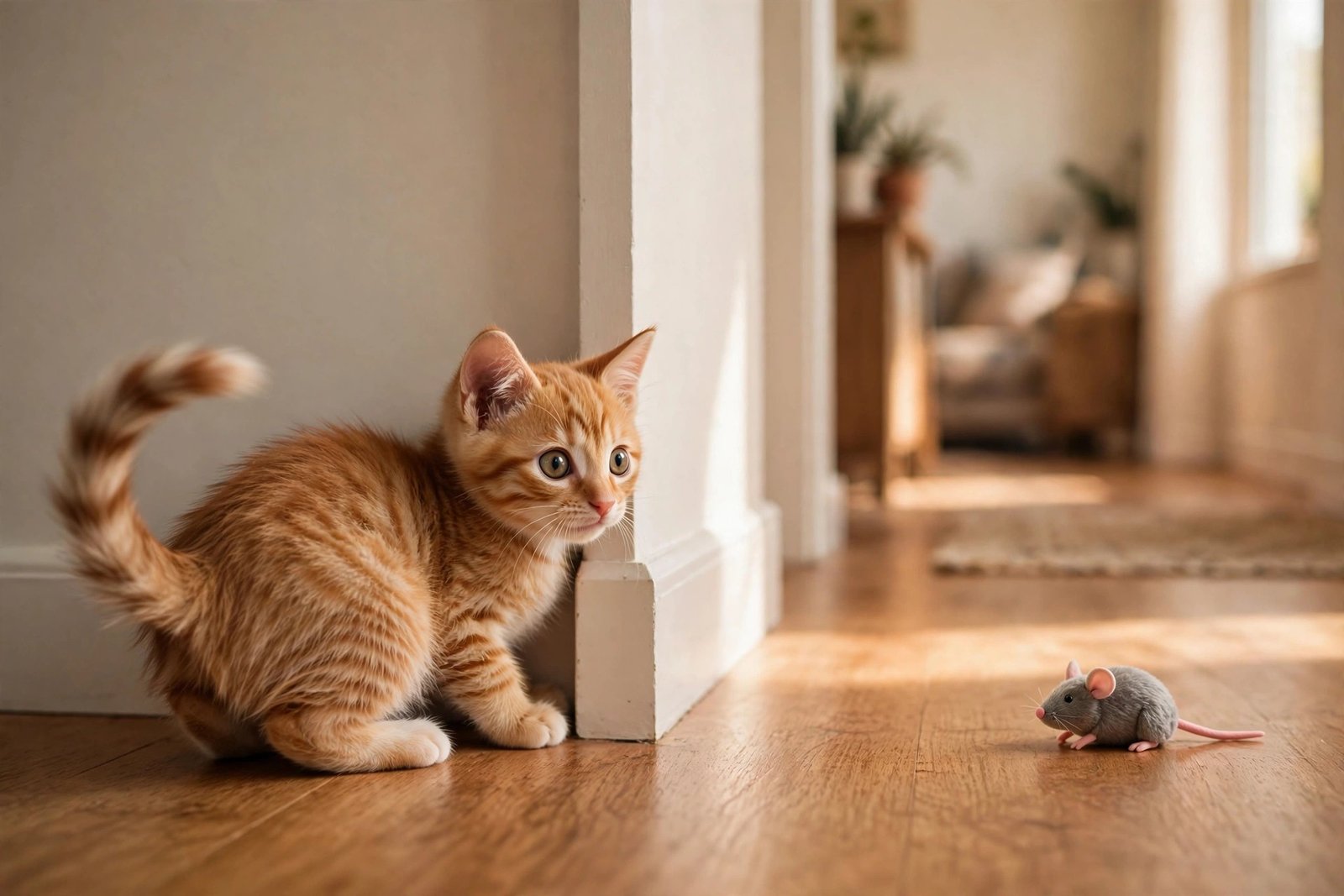
You walk down the hallway carrying a laundry basket, and out of nowhere two paws wrap around your ankle, teeth close gently — or not so gently — on your trouser leg, and your cat bunny-kicks before vanishing at high speed. Ankle attacks are one of the most common complaints from indoor cat owners, and they are almost never what they look like. Your cat is not being nasty, dominant, or spiteful. She is hunting the only moving prey her indoor world provides: you.
This guide explains play aggression, how to tell it apart from real aggression, why hands and feet must never be toys, and the simple play-session structure and in-the-moment response that turn an ankle hunter into a toy hunter.
Quick Answer
Ankle attacking is play aggression: your cat’s hunting sequence — stalk, chase, grab, bite, kick — aimed at moving feet because they look like prey and because no better target is on offer. It is most common in young, indoor, under-played cats. The fix is to redirect the hunt: daily wand-toy play sessions, never playing with hands or feet, toys she can grab and kick, and a calm in-the-moment response — go still, then redirect onto a toy, or walk away quietly. Pulling your foot away and squealing makes the “prey” more exciting and the game better, so stillness is your best tool.
What Play Aggression Actually Is
A cat’s hunt is a fixed sequence: watch, stalk, chase, grab, bite, and kick, followed by the satisfaction of a “kill” and a meal. Kittens practise this sequence on their littermates hundreds of times, and it is how they learn the skill every cat is born to use. Indoors, the instinct does not switch off. If the day contains no stalk-and-chase opportunities, a walking human ankle — moving, low to the ground, appearing and disappearing past furniture — is a nearly perfect stand-in for a mouse.
Play aggression is therefore a compliment to your cat’s health, in a way: her instincts are working exactly as designed. The problem is only the target. Owners who understand this stop feeling attacked and start feeling scheduled — as if their cat has been booking hunting practice on the nearest available legs.
Play Aggression vs Real Aggression: How to Tell
The two look different once you know what to watch for.
- Play aggression: silent approach, no hissing or growling; ears usually forward or neutral; body low in a stalking crouch with a wiggling bottom; the cat often races away afterwards or rolls over; bites are usually inhibited (pressure, rarely breaking skin); it happens around movement, at predictable times like morning and evening “hunting hours,” and the cat is relaxed and friendly the rest of the time.
- Real aggression: comes with warnings — hissing, growling, flattened ears, puffed tail, hard staring; happens during handling, approach, or guarding, not around moving feet; bites are harder and meant to drive you away; the cat stays tense afterwards rather than bouncing off to play.
Reading these signals is a general cat skill: our guide on reading your cat’s eyes and body language goes deeper into ears, tails, and posture. If what you are seeing looks like real aggression, appears suddenly in an older cat, or targets one spot on her own body with biting and chewing, ask the vet to check for pain — sudden behaviour change is often medical first.
The Golden Rule: Hands and Feet Are Never Toys
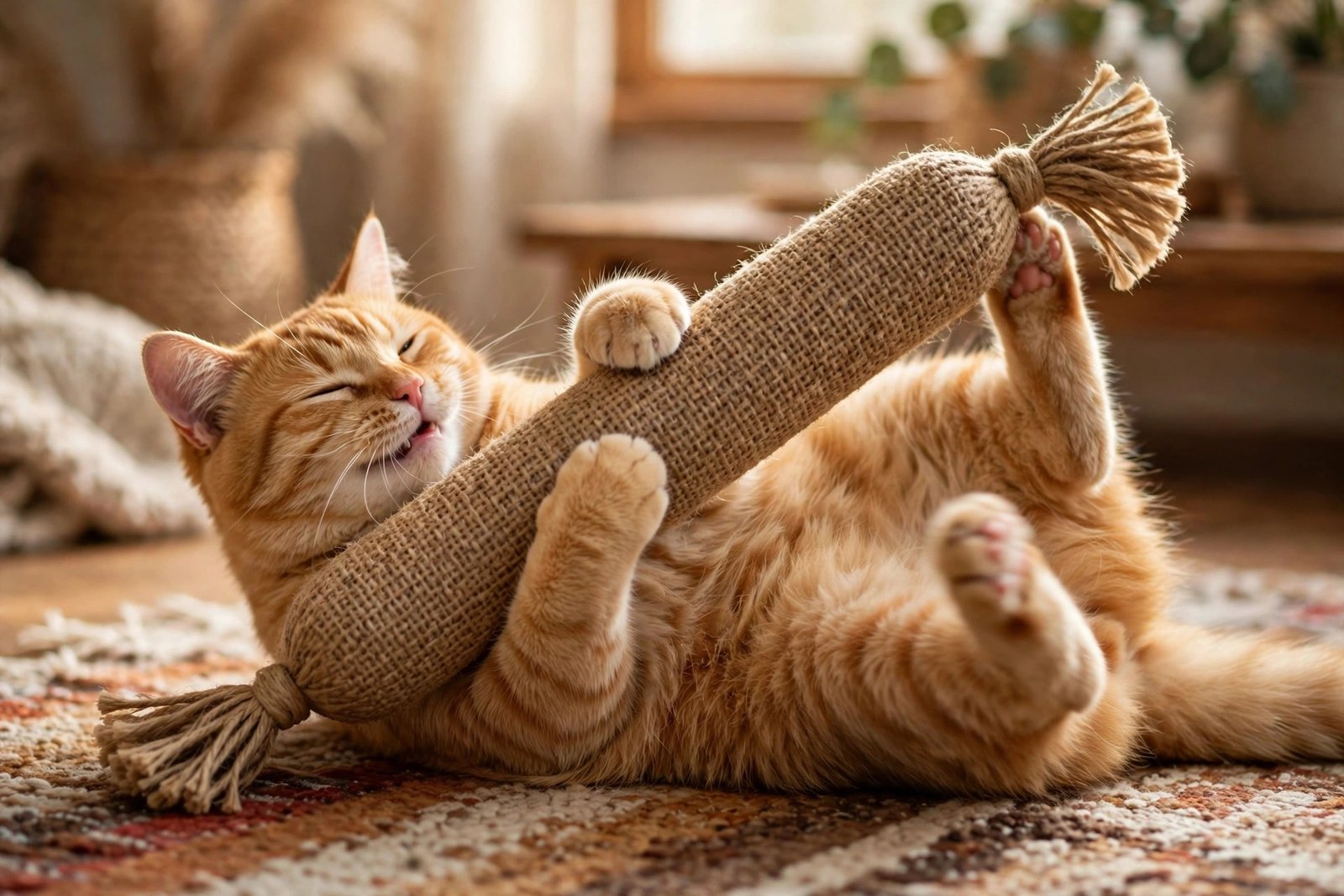
Many ankle attackers were trained, with love, as kittens: someone wiggled fingers for the tiny cat to chase, wrestled her with a hand, or let her chew toes in bed because it was cute. The kitten learned a lesson she still believes: human body parts are fair game. A six-month-old’s love bites are charming; a four-kilo adult launching the same game is not — but from the cat’s side, the rule never changed.
So the whole household needs one clear rule from today: play happens with toys, always at toy’s length from skin. No finger-wiggling games, no hand-wrestling, no toes under the blanket as lures. When she does grab a hand or ankle, do not wrestle free dramatically — that is the best part of the game for her. Go still, and follow the plan below.
What to Do in the Moment
- Go still. Prey struggles; furniture does not. The moment your ankle stops moving and you stop squealing or hopping, the “hunt” becomes boring.
- Redirect. Carry a small toy in your pocket during the danger weeks, or keep wand toys stashed around the house. Toss or trail the toy away from your leg the moment she lets go — or before she pounces, if you spot the crouch and wiggle.
- Walk away calmly if she persists. Leaving removes both the prey and the audience. A minute behind a closed door resets the game completely.
- Never punish, spray, shout at, or scare her. She is playing, not offending. Punishment frightens a cat mid-play and can convert happy play aggression into genuine fear aggression — a real problem in place of a solvable one.
The Long-Term Fix: Structured Play Sessions
In-the-moment calm handles single attacks; scheduled play removes the need for them. Aim for two or three sessions of ten to fifteen minutes a day with a wand toy, timed for her natural hunting peaks — early morning and evening work well for most cats.
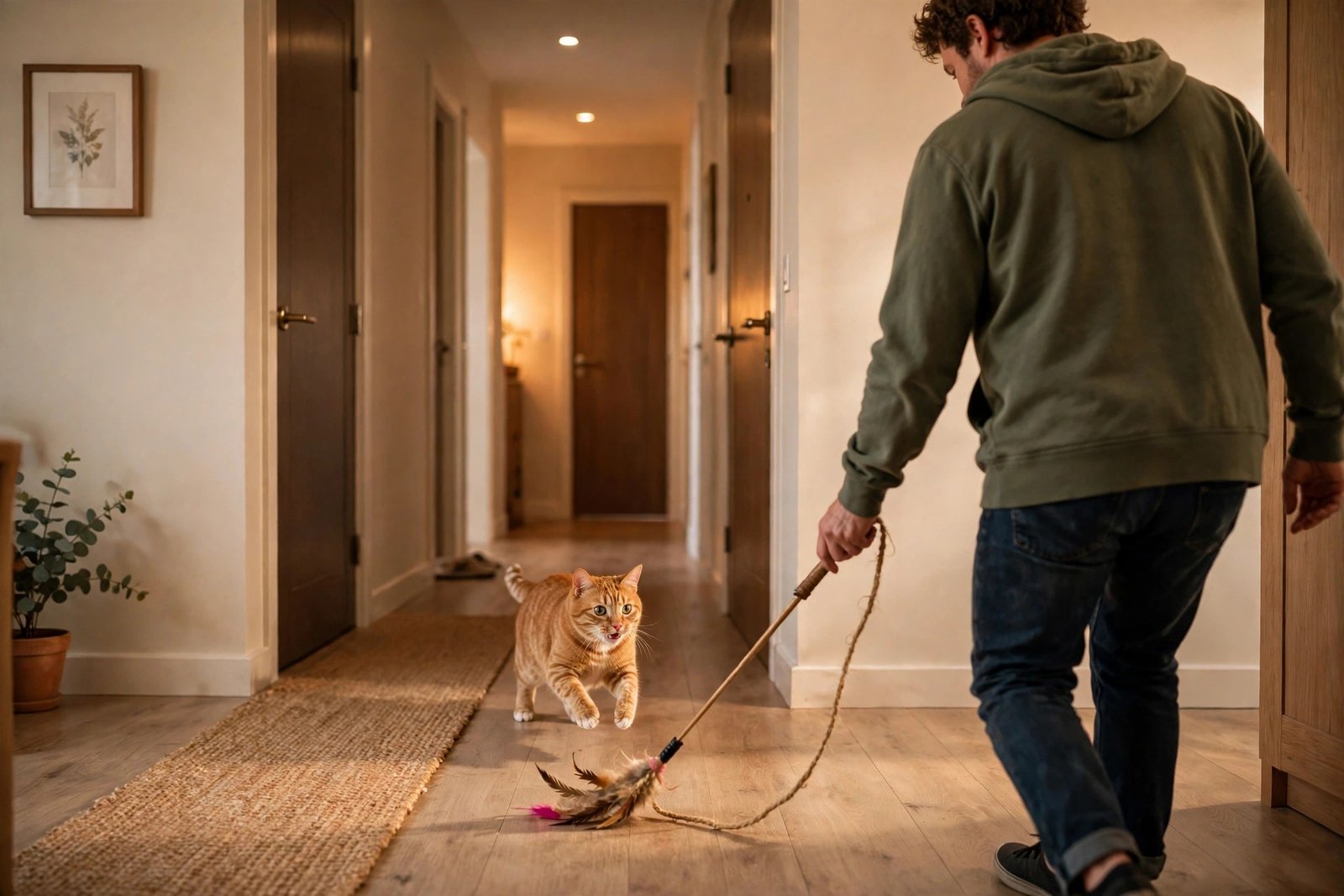
Play like prey, not like a helicopter. Drag the toy away from her, around corners, and under a rug’s edge; let it freeze, tremble, and hide; vary the speed; and let her catch it regularly — a hunt that never succeeds is frustrating, not satisfying. Finish each session with a final catch, then feed a meal or a few treats. This completes the hunt–catch–eat pattern and tells her body to rest and groom, which is why evening sessions followed by supper are famous for producing quiet nights. If your cat also explodes around the house at night, the same routine is the core fix in our guide to cat zoomies at 3 a.m.
Add grabbable hardware, too: kicker toys she can wrap her paws around and bunny-kick give the grab–bite–kick part of the sequence a legal target at any hour, including when you are asleep or at work. Several around the house — especially near her favourite ambush corners — catch a lot of would-be ankle attacks.
Set Up the Hallway for Success
Ambushes happen where prey predictably passes and cover is good: hallway corners, the bottom of stairs, beside the sofa. You cannot redesign your home around a cat, but small changes help while training takes hold. Leave a toy in the classic ambush spots so there is an alternative target at paw’s reach. Wear slippers or shoes during the retraining weeks rather than padding past in socks. And watch the schedule: an attack cluster just before dinner usually means a hungry, keyed-up hunter — moving the evening play session to just before the evening meal redirects that energy perfectly. Frequent attacks are also one of the clearest entries on the list of indoor cat boredom signs — treat the boredom and the ankles usually recover together.
Mistakes to Avoid
- Never punish, spray, shout at, kick out at, or scare a cat for ankle attacks. She is practising a survival skill on the wrong target; fear will not retarget her, it will only damage trust and can create true aggression or hiding.
- Do not pull your foot away quickly, hop, or squeal. To a hunting cat, that is prey behaving perfectly.
- Do not wrestle back, pin her, or turn the grab into a rough game. You are rehearsing exactly the behaviour you want to end.
- Do not keep playing with your hands “just sometimes.” One rule, every person, every day — cats learn the exception, not the intention.
- Do not assume she will simply grow out of it while nothing changes. Young cats do mellow, but a rehearsed daily habit can persist for years without a better outlet.
Frequently Asked Questions
Why does my cat attack my ankles but not my partner’s?
Usually because one person is more “fun”: you may move faster, react more, wear trailing trousers, or historically played the hand games. Cats also target whoever feeds and plays with them most — you are the centre of her world, so you are the centre of her hunting world too. The fix is shared: everyone plays with toys, everyone goes still during an ambush, and reactions get boring from all directions.
My cat bites hard enough to break the skin. Is that still play?
Young cats who were separated from littermates early sometimes never learned bite inhibition, so their “play” bites land too hard even though the intent is play. The body language still tells the truth: silent, forward ears, and a quick bounce away afterwards. Treat the cause the same way — redirect and enrich — but take skin-breaking bites seriously for hygiene (clean any bite promptly, and seek medical advice for deep or infected-looking bites) and mention it to your vet if it keeps happening.
How long until the ankle attacks stop?
With daily structured play and consistent stillness-and-redirect responses, most owners see a clear drop within two to three weeks, and ambushes become occasional rather than scheduled. Kittens and very young cats take a little longer because their hunting drive is at its peak. If attacks increase despite good play, or come with growling and real tension, ask the vet or a behaviour professional to look closer.
Are kicker toys and wand toys really enough?
For most cats, yes — together they cover the full hunting sequence: the wand provides the stalk and chase, the kicker provides the grab, bite, and kick. Add a meal after play and the sequence completes with eating and rest, which is the whole point. The toys themselves are simple; what makes them work is that they are used interactively, every day, at roughly the same times.