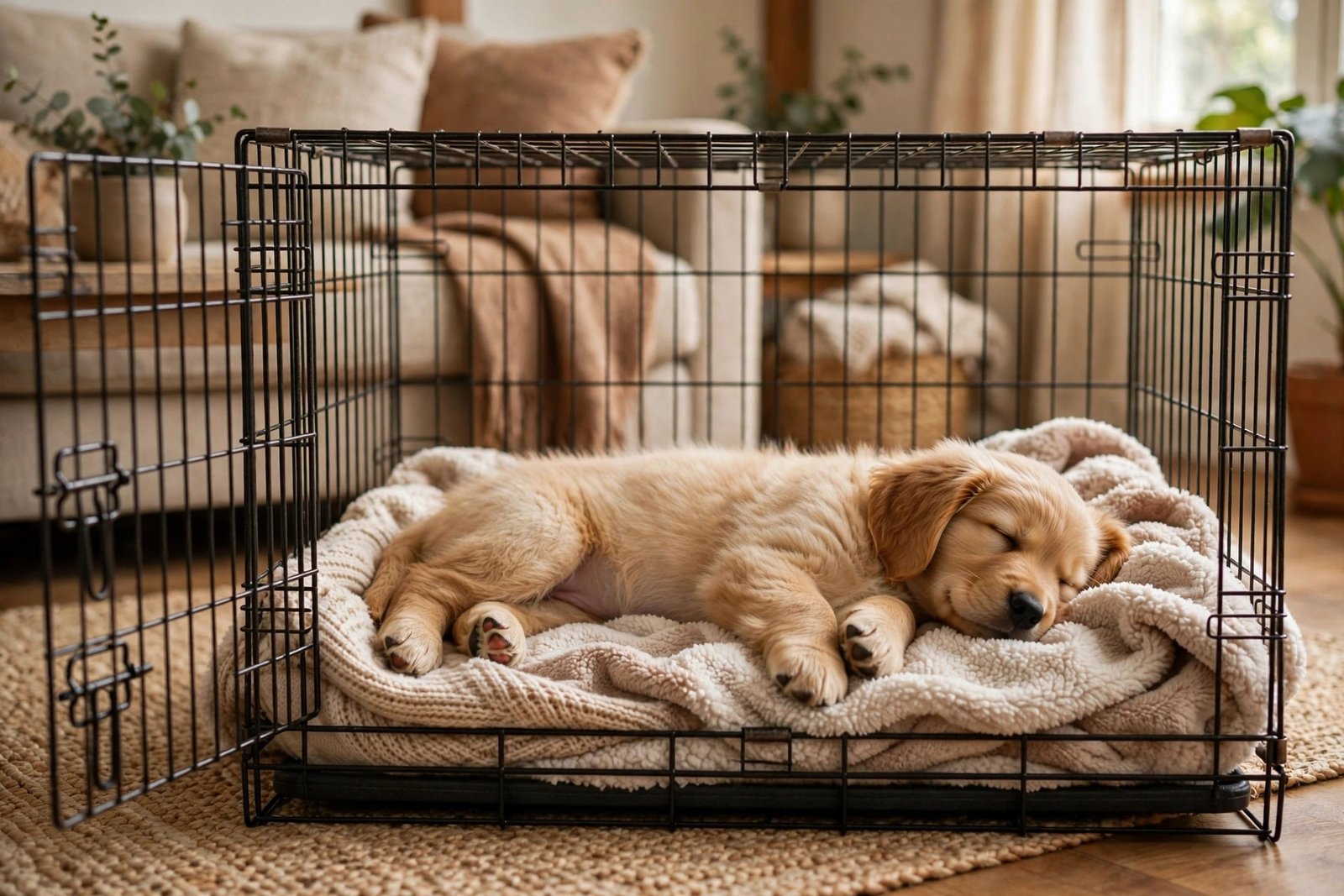
A crate, introduced kindly, becomes a puppy’s own den — a safe, quiet place to sleep, rest, and feel secure, and a genuinely helpful tool for house training and safe travel. But the whole plan depends on size. Too small, and the crate is unkind. Too big, and a puppy will sleep at one end and toilet at the other, which defeats the house-training purpose entirely. The good news is that correct sizing is simple once you know the rule, and a divider lets one crate grow with your puppy.
This guide covers the sizing rule, how to measure, the divider trick, wire versus plastic crates in general terms, and — just as important — the gentle introduction routine that makes the crate a happy place. No brands, just sizes, features, and kind methods.
Quick Answer
Choose a crate in which your puppy (and later, your adult dog) can stand up fully without ducking, turn around easily, and lie down stretched out on his side with legs extended. Measure your dog from nose to tail base and add about 10 cm (4 inches); measure his height to the top of his head while standing and add 5–10 cm — the crate’s inside should be at least those numbers. For a growing puppy, buy the size he will need as an adult for his breed’s expected build, and use the divider panel to shrink the space to his current “just right” size, moving it as he grows. Then make the crate a den, never a punishment: door open at first, meals and treats inside, and very short closed-door sessions that build slowly.
The Sizing Rule, Explained Simply
Three movements decide the fit. Your dog must be able to:
- Stand at full height with his head up, without his ears or head pressing the roof.
- Turn around in a full circle without squeezing or climbing the walls.
- Lie stretched out on his side, legs extended, not forced to curl. Dogs sleep properly stretched; a crate that only allows curling is too small.
Why not simply buy huge? Because for house training, the crate works through a puppy’s natural wish to keep his sleeping area clean. Given a palace, he will happily toilet in the far corner and sleep in the near one. The right size is snug but never cramped — a bedroom, not a cage and not a ballroom. If you are crate training alongside toilet training, this pairing is covered in our guide on how to potty train a puppy in an apartment.
How to Measure Your Puppy (and Guess the Adult)
- Length: from the tip of the nose to the base of the tail, while standing. Add roughly 10 cm (4 inches) for the crate’s minimum internal length.
- Height: from the floor to the top of the head (or ear tips, if they stand up) while standing tall. Add 5–10 cm for headroom.
- For a puppy, measure the adult he will become. Use the typical adult size for his breed or mix — your vet can give a good estimate at his check-ups. Buy once for the adult, then divide.

The Divider: One Crate From Puppyhood to Adult
Many wire crates include a divider panel, and it is the smartest feature you can choose. The divider walls off part of the crate so the puppy’s space is always the “stand, turn, stretch” size for his current body. Every couple of weeks, as he grows, move the panel back a few centimetres. This keeps the house-training benefit the whole way through, avoids buying three crates in a year, and means the dog never has to adjust to a strange new den — the same crate simply gets roomier. If the crate you like has no divider, a sturdy box or panel that cannot be chewed, climbed, or trapped against can do the same job temporarily, but a proper fitted divider is safer and easier.
Wire, Plastic, or Fabric? A General Comparison
- Wire crates fold flat, ventilate well, let the puppy see the room, and usually include the divider. They suit most home training. A blanket draped over part of the top adds den-like cosiness — leave airflow at the front.
- Plastic (airline-style) crates are more enclosed and den-like, which some nervous puppies prefer, and they contain travel messes well. They rarely include dividers, so sizing up may mean a second purchase.
- Soft/fabric crates are light and comfortable but only suit calm, older dogs who are already crate-trained — a teething puppy can chew through one in minutes. Think of them as luggage for trained dogs, not training tools.
Whichever type you choose, check door latches a puppy cannot paw open, smooth edges, and a removable tray for easy cleaning. For car journeys and vet trips, a separate carrier is often more practical — our guide to travel carrier training basics covers choosing and introducing one kindly.

Make the Crate a Happy Place: The Kind Introduction
Size gets the crate right physically; this routine gets it right emotionally. Rush it, and the crate becomes a prison in your puppy’s mind. Go slowly, and it becomes his favourite nap spot.
- Days 1–2: set the crate up in the room where the family spends time, door fixed open, with soft bedding and a safe chew inside. Let the puppy wander in and out freely. Feed meals just inside the door. Never push him in.
- Days 3–4: once he pops in happily, close the door for a few seconds while he eats, then open it before he finishes worrying. Build to a few minutes, staying in the room.
- Then: add short rests after play and toilet trips, when he is naturally sleepy. Stay nearby at first; leave the room briefly and return calmly. Night crying is normal at the start — our guide on a puppy crying at night in the crate walks through those first nights kindly, step by step.
- Always: toilet break right before crate time and straight after. Puppies cannot hold on long — a rough guide is one hour per month of age, and less when awake and playing.
Mistakes to Avoid
- Never use the crate as punishment. No sending a puppy to the crate in anger, ever — it must always mean rest and safety, or it stops working for everything.
- Do not buy “room to grow” without a divider. An oversized, undivided crate is the single most common cause of crate toilet accidents.
- Do not leave a puppy crated for long stretches. Beyond night-time sleep, young puppies need frequent toilet breaks, play, and company; a crate is a training tool, not storage.
- Do not force the pace — dragging a frightened puppy in, or closing the door for an hour on day one, builds fear that takes weeks to undo.
- Remove collars before crate time to avoid any chance of catching on bars, and keep chew items to safe, puppy-appropriate ones — never leave a puppy unsupervised with small or splintering chews.
- Do not give up after one noisy night. Crying at first is communication, not failure. Follow the gradual routine and keep nights predictable.
Frequently Asked Questions
What if my puppy keeps having accidents in a correctly sized crate?
First, check the schedule: most crate accidents are timing, not sizing — he was left a little too long, or crated straight after drinking a lot. Add a toilet break immediately before and after. If accidents continue, or come with straining, unusual smell, or drinking much more, see your vet to rule out a urinary problem rather than changing crates.
How long can a puppy stay in a crate at night?
Young puppies usually need at least one toilet trip during the night, even if they sleep well otherwise. Expect to set an alarm for the first weeks: take him out quietly, toilet, praise softly, and straight back to the crate. As bladder control grows over the first months, most puppies sleep through — but let the puppy’s progress, not the calendar, set the pace.
My puppy screams when the door closes. Am I doing it wrong?
You are probably just moving faster than he can handle. Go back a step: door open, meals inside, tiny closed-door moments measured in seconds, and build again more slowly. Let him out before panic, not in response to peak screaming, so he learns calm works — and if distress is extreme or constant, a vet check and a qualified trainer’s help are worthwhile.
When can I stop using the divider?
When your dog is reliably clean in the crate and approaching adult size — usually somewhere in the second half of the first year. Remove it and give him the full space; at that point the extra room is comfort, not a toilet invitation, because the clean-den habit is established.

1 thought on “How to Choose a Puppy Crate Size (and Make the Crate a Happy Place)”