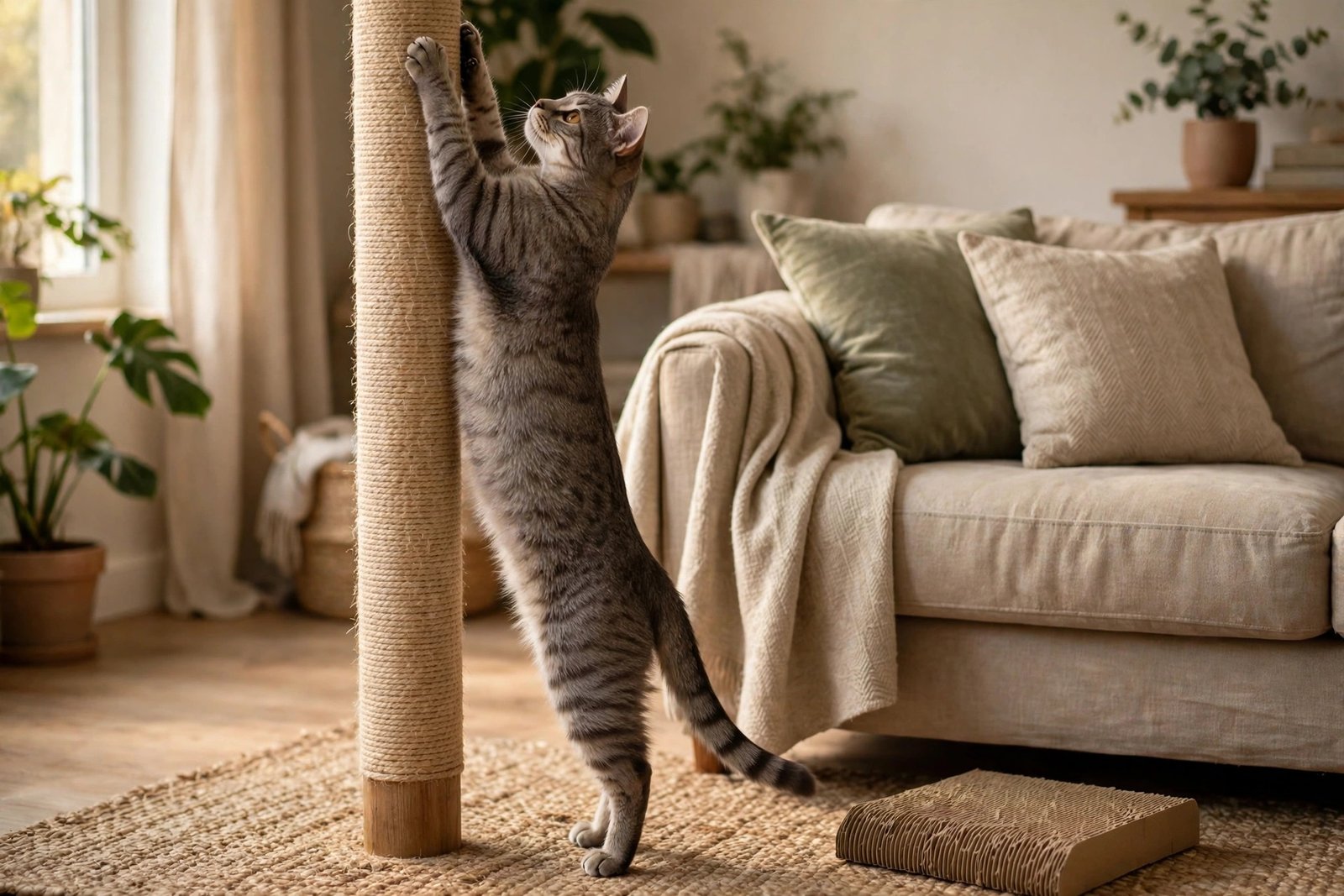
Your cat needs to scratch. It is not bad behaviour, and it is not optional. Scratching keeps claws healthy, stretches the back and shoulders, and leaves scent marks that help a cat feel at home. The only real question is where your cat will do it — on something you chose, or on the corner of your sofa. That is why the scratching post versus cardboard scratcher choice matters: the best scratcher is the one that matches how your cat already likes to scratch.
This guide compares the two honestly — what each does well, where each falls short, and how to read your cat’s own preference before you spend anything. No brands, just the features that decide which one your cat will actually use.
Quick Answer
Choose a tall, sturdy scratching post if your cat scratches upright — on sofa arms, door frames, or chair legs — because posts let a cat stretch fully upwards, and a wobbly or short post will be ignored. Choose a cardboard scratcher if your cat scratches flat surfaces like rugs and carpets, prefers lying-down scratching, or loves shredding; cardboard is cheap, light, and easy to replace. Many cats do best with both: one vertical option and one horizontal option in different rooms. Whichever you pick, placement matters more than price — put it right beside the place your cat already scratches, and praise every use.
First, Understand What Your Cat Is Telling You
Before comparing products, watch your cat for a few days. Cats are consistent, and their current habits predict what they will accept:
- Vertical scratchers rear up, stretch tall, and drag their claws downwards on upright surfaces — sofa arms, the side of an armchair, a door frame, wallpaper at standing height.
- Horizontal scratchers crouch low and pull their claws towards themselves across flat ground — rugs, carpets, doormats, the seat of a chair.
- Angled scratchers do a bit of both, often on stairs or sloping chair legs.
Also note texture. Some cats love the rough pull of rope or fabric; others want a surface their claws can really dig into and shred. If your cat is already ruining one particular thing, our guide to a cat scratching the sofa explains how to move that behaviour onto an acceptable target step by step — the same placement logic applies to whichever scratcher you choose.

The Scratching Post: Strengths and Weaknesses
What a post does well
A good post gives a cat the full-body stretch that vertical scratchers crave. It stands in one place for months or years, becomes a fixed scent-marking landmark, and often doubles as a lookout or a climbing route if it is part of a taller tower. Sisal-wrapped posts offer a tough, grippy surface that stands up to daily use, and a heavy, wide base keeps the post steady while a cat leans its whole weight into the scratch.
Where posts fail
Most rejected posts fail on two simple points: height and stability. A post must be tall enough for your cat to stretch at full length — for most adult cats that means at least 70–80 cm of scratching height — and solid enough not to rock. A post that wobbles once will be avoided for good; cats do not trust furniture that moves under them. Carpet-covered posts are another common miss: the loops can catch claws, and carpet teaches a cat that carpet-like textures are for scratching, which is the opposite of what most owners want. Posts also take up permanent floor space, and a worn one is harder to refresh than a cardboard pad.
The Cardboard Scratcher: Strengths and Weaknesses
What cardboard does well
Corrugated cardboard has a texture many cats find irresistible: claws sink in, catch, and shred with a satisfying rip. Flat pads suit horizontal scratchers perfectly, angled boards work well on sofas and stairs, and some designs double as a lounger, so the cat scratches, then naps on the evidence. Cardboard is light enough to move from room to room, easy to store, and simple to replace when worn — you flip it over for a second life, then recycle it.
Where cardboard fails
Shredding is the point, but it is also the mess: cardboard sheds flakes and confetti across the floor, which some owners mind more than others. A flat pad cannot give a determined vertical scratcher the stretch she wants, and lightweight boards can slide or flip while a strong cat works on them unless they sit inside a frame or against a wall. Cardboard also wears out in weeks to a few months depending on the cat, so while each piece is cheap, it is a repeating purchase rather than a one-time fix.
Side-by-Side: The Features That Actually Decide It
- Scratch direction: post wins for vertical; cardboard wins for horizontal; angled boards bridge the gap.
- Stretch: only a tall post (or tall tower) lets a cat stretch fully upright.
- Stability: a heavy-based post is rock solid; cardboard needs a frame, a wall, or a non-slip mat under it.
- Lifespan: a sisal post lasts a year or more; cardboard lasts weeks to months but flips over for extra life.
- Mess: posts shed very little; cardboard confetti needs a quick sweep.
- Space: a post claims permanent floor space; a flat pad slides under furniture when guests come.
- Multi-cat homes: several cheap cardboard pads in different rooms can beat one shared post, because cats prefer not to queue for scent-marking spots.

How to Introduce the Winner So Your Cat Actually Uses It
Even the perfect scratcher fails in the wrong place. Put the new scratcher directly beside — or in front of — the surface your cat already scratches, even if that spot is awkward. Rubbing a little catnip or a favourite blanket on it can spark the first try, and a short play session next to it helps too. Praise and reward every use, and only once the habit is set, move the scratcher gradually — a few centimetres a day — to where you would rather keep it. If your cat is generally under-stimulated, scratching troubles often travel with other restlessness; the signs in our guide to indoor cat boredom signs will help you spot whether a wider enrichment fix is needed alongside the new scratcher.
Mistakes to Avoid
- Do not buy the scratcher you like the look of and ignore your cat’s scratch direction. Match the cat first, decorate second.
- Do not tuck a new scratcher away in a spare room or laundry corner. Cats scratch where they live and socialise — out of sight means unused.
- Do not choose a short, light post that wobbles. One scare is enough to put a cat off it permanently.
- Do not punish scratching on furniture — never spray, shout at, or scare your cat for it. Scratching is a need; redirect it kindly and protect furniture with covers while the new habit forms.
- Do not throw away a worn cardboard pad too early — flip it over first — and do not keep a post so frayed that loose strands tangle claws.
- Do not declaw, ever. It is an amputation, it is harmful, and it is never the answer to a scratching problem that the right scratcher and placement can solve.
Frequently Asked Questions
My cat ignores the new post completely. What should I do?
Move it directly in front of the furniture she currently scratches, check that it is tall and completely steady, and make it interesting with catnip or play beside it. Most “ignored” posts are in the wrong place or too short, not the wrong product. Give it two weeks in the prime spot before judging it.
Can I train a vertical scratcher to use a flat cardboard pad?
You can offer it, and many cats enjoy both, but do not expect a committed vertical scratcher to give up stretching. An angled cardboard board is a good compromise. If her heart is set on upright scratching, a proper tall post will save your furniture far better than hoping she changes style.
How many scratchers does one cat need?
At least one near her main sleeping area — cats love a stretch-and-scratch on waking — and one near the furniture she targets. Two or three well-placed scratchers, in a mix of styles, suit most homes. Boredom-driven furniture damage often improves at the same time, just as providing safe targets calms the habit behind a cat knocking things off tables.
When should I replace a scratcher?
Replace cardboard when both sides are shredded down to a soft, flattened surface that claws no longer catch. Re-wrap or replace a post when the sisal is hanging in loose strands or the core is exposed. A scratcher that no longer “works” under the claws sends cats straight back to your furniture.
