
Your cat looks you in the eye. Slowly, deliberately, one paw slides your mug, your keys, or your phone towards the edge of the table — and over it goes. If you live with a cat, this scene is probably very familiar. It can feel like pure mischief, almost like your cat is testing you. The truth is kinder and simpler: knocking things off tables is normal cat behaviour with real reasons behind it, and once you understand those reasons, you can reduce it a lot without any battles.
This guide explains why cats push objects off edges, how to tell curiosity from an attention habit, and the calm, practical steps that protect your things while giving your cat better outlets for the same urges.
Quick Answer
Cats knock things off tables mainly for three reasons: curiosity (pawing an object is how a cat tests whether it is alive, safe, or interesting), hunting instinct (a moving object triggers the chase), and learned attention (if you jump up every time, your cat learns that one small push gets you to react). The fix is not punishment. Move breakables out of reach, stay calm and boring when something falls, and offer play sessions and food puzzles that satisfy the same instincts. Most cats push far less often within a few weeks once the reaction stops paying off and the energy has somewhere better to go.
Reason One: Pawing Is How Cats Investigate the World
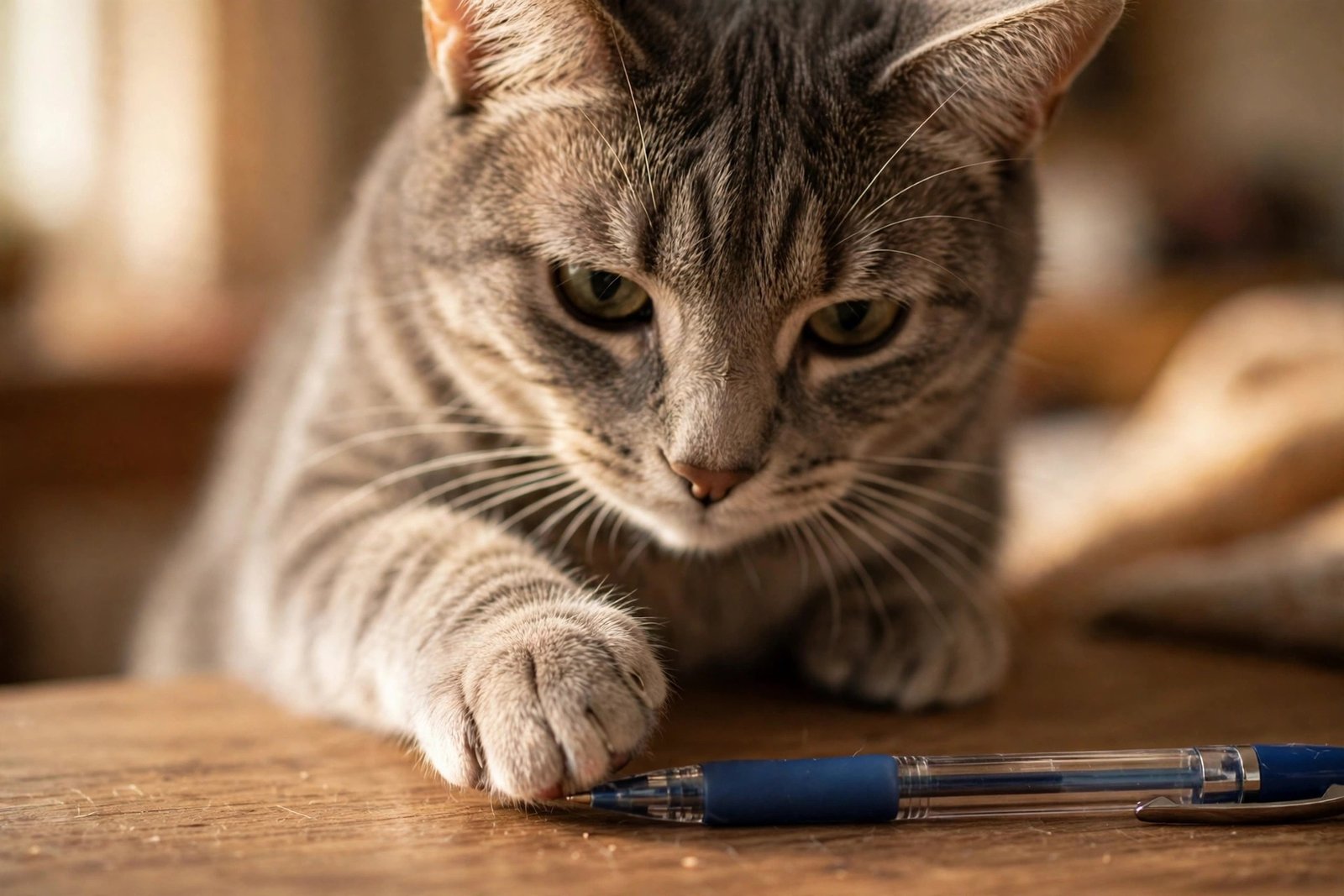
Cats do not have hands, so they use their paws the way we use our fingers. A gentle tap tells a cat a great deal: is this thing alive? Is it food? Will it move, roll, or make a sound? Wild cats pat at prey before committing to a pounce, and your house cat uses exactly the same careful testing on a pen, a bottle cap, or a pair of sunglasses.
This is why the pushing often looks so thoughtful. Your cat is not being careless; she is running an experiment. Objects that move in an interesting way — rolling, wobbling, sliding — get pushed again, because movement is information. Objects that sit still and do nothing usually get one tap and are left alone.
A curious cat’s body language gives her away: ears forward, eyes bright, paw reaching out gently rather than swatting hard. If your cat often pauses to watch you with that same bright, focused look, our guide on why your cat stares at you will help you read what she is paying attention to.
Reason Two: The Push Often Ends in a Chase
When an object drops, it moves fast, bounces, rolls, and sometimes makes an exciting noise. To a hunter’s brain, that is a small celebration. The falling item mimics escaping prey, and many cats leap down after it, bat it across the floor, and enjoy a short game they created themselves.
This is also why lightweight, rollable things are the usual victims: pens, hair ties, bottle tops, lip balm tubes. Heavy or boring objects rarely get a second push. Your cat is, in a sense, making her own toys out of whatever the table offers — which is a clear hint that giving her real toys to chase will take some of the pressure off your belongings.
Reason Three: Your Reaction Is the Real Prize
Here is the part most owners miss. If every push brings you running — talking, laughing, scolding, picking up the item and handing back attention — your cat files that away as a reliable button to press. Cats are excellent students of cause and effect. A cat who has learned that one slow push summons her favourite person will use that trick whenever she wants company, play, or food.
Watch for the telling detail: the cat who checks your face before and during the push is usually running the attention experiment, not the object experiment. The stare, the pause, the slow slide — she is watching you, not the mug. Attention-seeking pushing is especially common in cats who are a little under-stimulated, and it often travels with other signs we cover in our guide to indoor cat boredom signs.
Step One: Protect Your Things First
Before any behaviour work, make the easy management changes. They work instantly and they remove the stress of worrying about damage while you teach.
- Move breakables, full glasses, and anything precious off the edges and into drawers, cupboards, or rooms your cat cannot reach.
- Keep a small tray or basket on the table or desk as the landing place for keys, pens, and small loose items, so there is less sitting loose to push.
- Use closed containers for tiny temptations like hair ties and earbuds, which are also safer — swallowed string-like objects are a real emergency.
- Accept a little editing of your home: a cat-safe shelf layout beats a daily argument with a curious animal.
Step Two: Make the Fall Boring
When something does get pushed off, your job is to be dull. No gasp, no shout, no sprint across the room. Calmly pick the item up after a moment, put it away without comment, and carry on with what you were doing. If your cat is clearly doing it to start a game, do not start the game right then — wait a few minutes, then offer play on your terms.
This feels unnatural at first, but it is the heart of the method. Behaviour that stops producing a result slowly fades. The pushing may briefly increase for a day or two when your cat tests whether the old button still works; that short burst is a sign the lesson is landing, not failing. Stay consistent and every person in the home needs to follow the same calm script, because one laughing family member can keep the habit alive for months.
Step Three: Give the Instinct a Better Target
Reducing table pushing works far better when you add something instead of only taking something away.
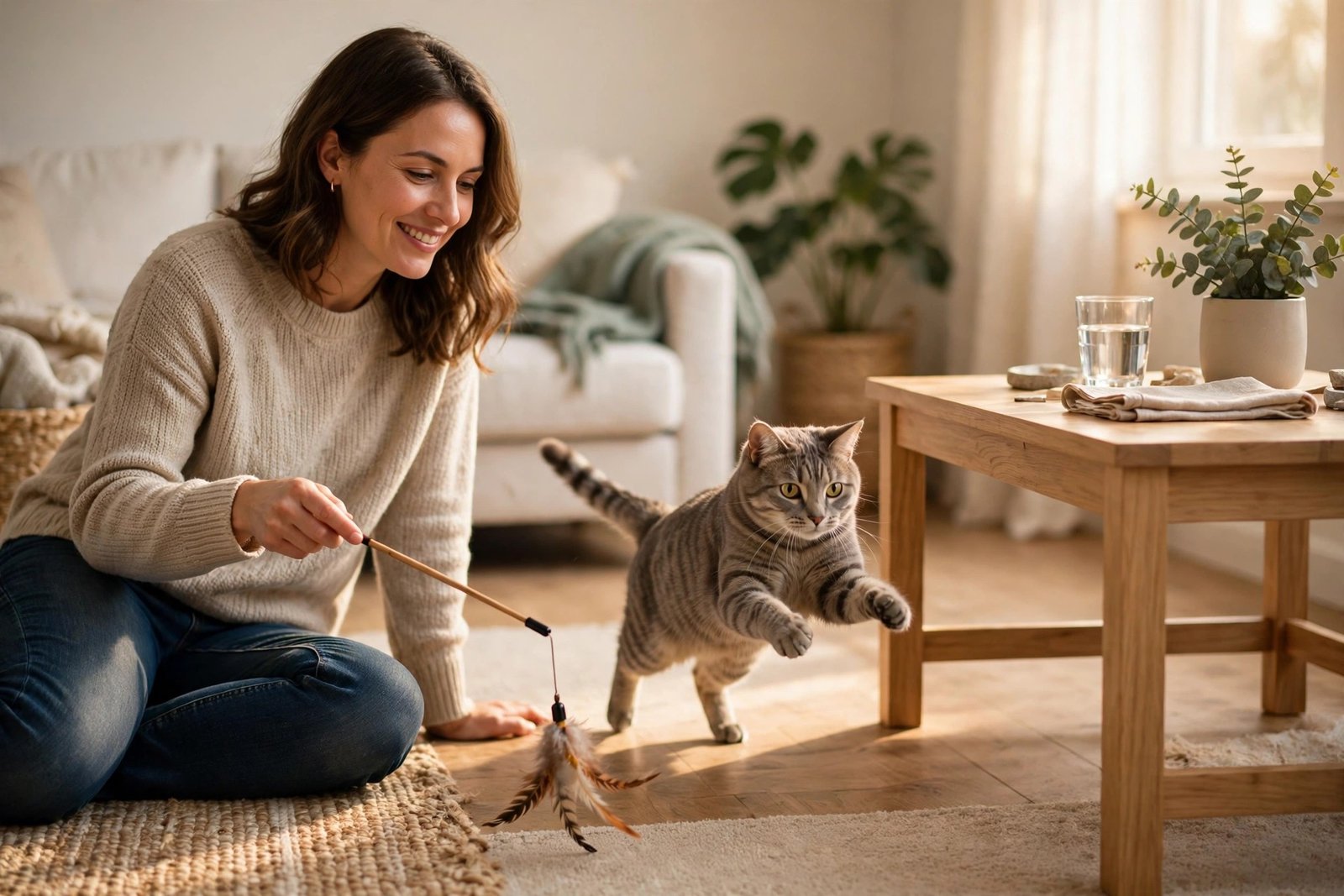
- Play sessions: Ten to fifteen minutes with a wand toy, twice a day, lets your cat stalk, chase, and pounce properly. End with a small meal or treat so the hunt feels complete.
- Food puzzles: A simple puzzle feeder or a few treats hidden in a cardboard box with scrunched paper gives paws and brain legal work to do.
- Approved pushing toys: Light balls, crinkle toys, and bottle-cap-style cat toys on the floor satisfy the bat-and-chase urge where it belongs.
- Rotate toys: Put half the toys away and swap them every few days. Old toys feel new again, and interest stays high.
Cats who get lively play tend to spend their table time washing and napping instead of conducting physics experiments. If your cat is young and generally very boisterous, you may also recognise the pattern in our article on play aggression and ankle attacks — the fix is the same: more structured play, less improvised hunting of household objects and people.
Mistakes to Avoid
- Never punish, spray, shout at, or scare your cat. A spray bottle or a scolding does not teach “do not push things”; it teaches “my person is frightening and unpredictable.” That damages trust and often makes attention-seeking behaviour worse, not better.
- Do not laugh and film it every time, then wonder why it continues. A delighted audience is a reward.
- Do not rush to grab your cat mid-push. Sudden grabbing can startle her into scratching or bolting, and it turns the moment into exciting drama.
- Do not leave the same tempting setup in place and rely on willpower — yours or the cat’s. Management first, training second.
- Do not push objects back towards your cat as a game on the table. You are rehearsing the exact behaviour you want less of.
When Pushing Might Mean Something More
Occasional object pushing is normal for life. But if the behaviour appears suddenly in an older cat, comes with restlessness, night vocalising, appetite change, or clumsiness, a vet check is sensible: pain, vision changes, and some age-related conditions can show up as changed behaviour first. Likewise, a cat who seems unable to settle at all, day or night, deserves a conversation with the vet or a qualified behaviour professional rather than stronger attempts at home training.
Frequently Asked Questions
Does my cat knock things off tables on purpose to annoy me?
Not out of spite — cats do not plot revenge. But yes, it can be deliberate in the sense that your cat has learned it works: the push produces movement, sound, and your attention. She is repeating a behaviour that pays off, which is exactly why removing the payoff, calmly and consistently, reduces it.
Why does my cat only push things when I am watching?
Because you are the point. Watching behaviour usually means the push is an attention tool: your cat wants interaction and has found a button that gets it. Give attention generously at other times — play, gentle fuss, and routine — and stay boring during the push itself, so the lesson becomes “attention comes easily, just not this way.”
Will a spray bottle stop my cat pushing things off the table?
It may interrupt the moment, but it does not teach your cat what to do instead, and it often teaches her to do it when you are not holding the bottle — or to fear you. Positive redirection, management of breakables, and more play work slower but last, and they keep your relationship intact.
How long does it take for the pushing to reduce?
With consistent calm reactions and daily play, most owners see a clear drop within two to three weeks. Expect a brief increase at the start when your cat tests the change. Highly curious kittens and young cats may always tap at new objects occasionally — that is normal investigation, and keeping valuables stored makes it harmless.

1 thought on “Why Does My Cat Knock Things Off Tables? And How to Reduce It”